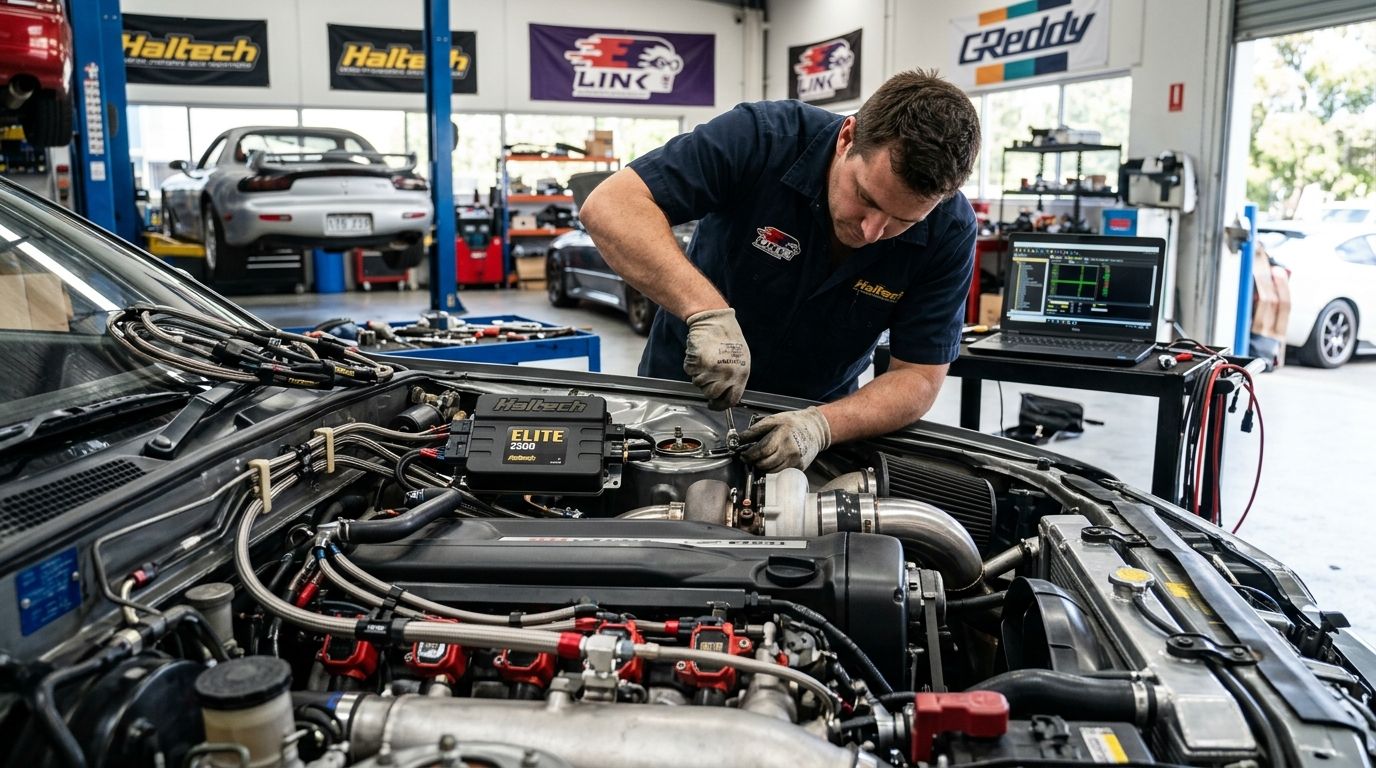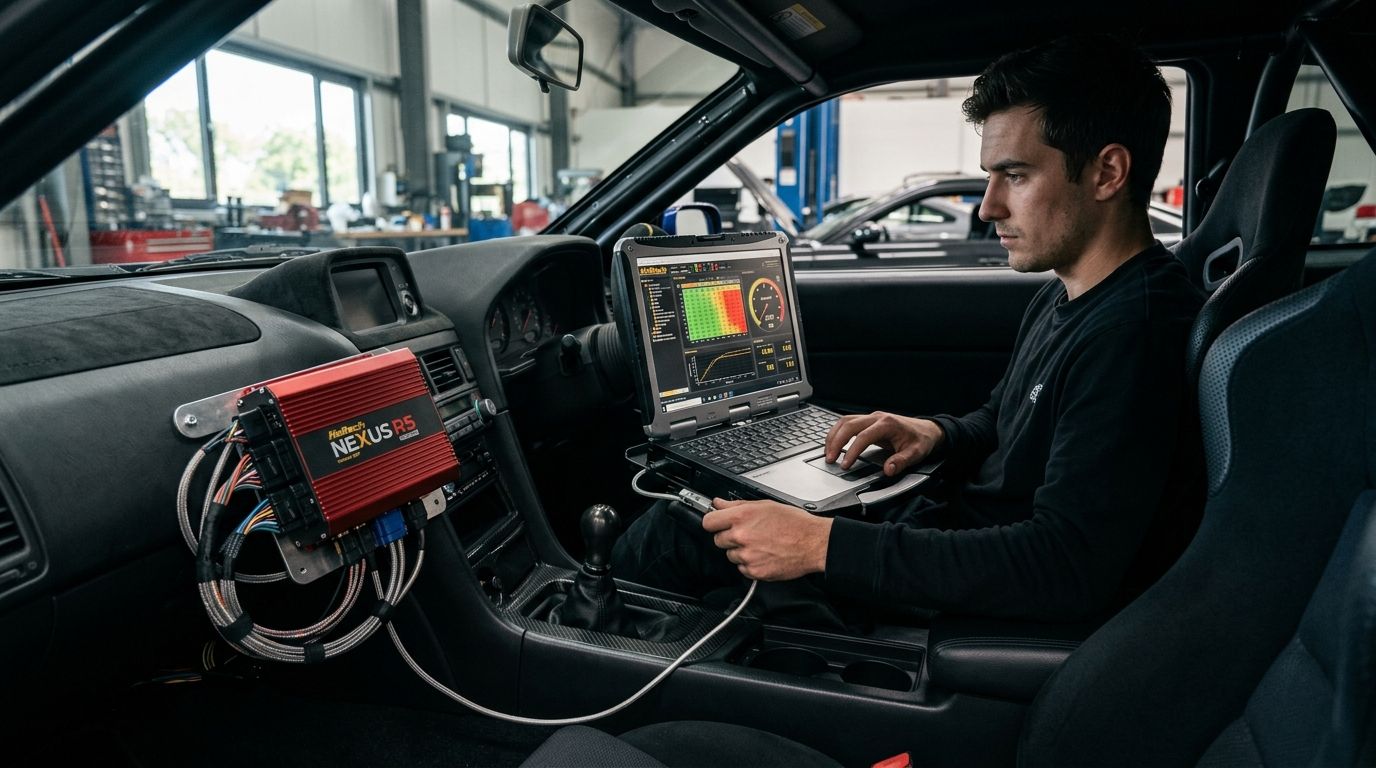
Yes, you can tune a Haltech ECU yourself using Haltech's own ECU Manager software, and the tuning software ships with the ECU rather than being sold separately. But self-tuning is only safe inside a defined hardware and experience envelope: naturally aspirated or mild-boost street engines with a wideband O2 sensor fitted. Past that envelope — forced induction, high compression, E85 — a DIY map without knock monitoring and dyno verification is how engines get damaged.
- Can you tune a Haltech ECU yourself? Yes, using ECU Manager, but only within your hardware and experience limits.
- Naturally aspirated and mild street builds are the realistic DIY zone in 2026.
- Forced induction, high compression and E85 combinations need a dyno, wideband O2 and knock monitoring.
- Verify crank trigger and cam sync signals before touching any fuel or ignition table.
- Spool Imports supplies the Haltech ECUs, crank trigger kits and closed-loop hardware that make either path work.
Why this matters
A Haltech ECU is only as good as the map running on it. The hardware places no guard rail between you and a dangerous fuel or ignition table — the software hands you full authority over fuel, timing, boost and every sensor input the ECU reads.
That authority is exactly why the self-tuning question matters more with a Haltech than with a locked factory computer. On a factory ECU a bad flash gives you a rough idle. On a boosted engine with a standalone, a bad table gives you detonation, a lean-out event, and a bill for pistons and rods.
The practical decision in 2026 isn't "can I" — it's "does my combination tolerate the mistakes I'm going to make while learning".
Can you tune a Haltech ECU yourself?
Whether self-tuning is a reasonable call comes down to three things: induction type, fuel, and what monitoring hardware is already fitted. The table below splits the two realistic paths.
| Approach | Suits | Requires | Risk if done wrong | Verdict |
|---|---|---|---|---|
| DIY self-tune | Naturally aspirated or mild-boost street engines on pump 98 | Wideband O2, a base map from a similar combination, patience with closed-loop trims | Rich or lean idle and cruise, poor drivability, wasted fuel | Workable for low-stress combinations |
| Professional dyno tune | Forced induction, high compression, E85, anything chasing real power | Dyno time, knock monitoring, a tuner experienced on your platform | Detonation, lean-out, bent rods, holed pistons | Required past mild street tune territory |
| Hybrid: DIY base, dyno verification | Builders who want to learn but won't gamble the engine | Both of the above, plus a tuner willing to review your map | Low — the dyno session catches your errors | The sensible middle path |
The Haltech ECU tuning guide for performance workshops walks through the workflow a shop follows on a dyno. Read it even if you intend to tune at home — it shows what a professional session checks that a laptop-only road tune structurally cannot.
Self-tuning a Haltech ECU: the realistic street workflow
Self-tuning works when the combination is forgiving and the ECU has enough sensor input to correct itself in real time. The order matters more than most first-time tuners expect.
- Start from a base map matched as closely as possible to your displacement, compression ratio and induction type. Never start from a blank table.
- Verify the crank trigger and cam sync signals are clean before touching fuel or ignition. A noisy trigger produces symptoms that read exactly like a bad tune.
- Set up closed-loop fuel control with a wideband O2 sensor so the ECU trims toward a target air-fuel ratio instead of running an open-loop guess.
- Tune idle and cruise first, then part throttle, then wide-open throttle in small load steps.
- Watch knock feedback plus coolant and intake air temperature compensation at every stage, especially once you exceed factory boost levels.
- Log every session and review the logs cold, not in your driveway with the engine still running.
Petrol engines sit at roughly 14.7:1 air-fuel ratio at stoichiometric cruise and richen under load — that's the reference point every wideband and closed-loop table is built around. A naturally aspirated street engine on pump fuel with a wideband fitted is the realistic ceiling for a confident DIY Haltech self-tune in 2026.
Anything with a turbo, a compression ratio built for power, or E85 in the tank crosses that ceiling immediately.
“Verify the trigger signal before you touch a fuel table, or you will spend a weekend tuning around an electrical fault.”
When a professional Haltech dyno tune is worth paying for
Forced induction changes the risk profile completely. Boost stacks cylinder pressure and heat faster than a road tune can safely explore, and the gap between a strong pull and a lean-out event is measured in single air-fuel-ratio points, not a comfortable band you can eyeball off a gauge.
High-compression naturally aspirated combinations carry the same problem in a different shape: less ignition timing margin before detonation shows up, and detonation on a high-compression engine does its damage before you hear it.
E85 shifts the stoichiometric target to roughly 9.8:1. Fuel tables built for petrol are wrong from the first pull and need a full retune, not a scaling adjustment. Ethanol content also varies between fills, which is why flex-fuel sensing and a properly configured compensation table matter more than a single "E85 map".
For these combinations a dyno session with controlled load, exhaust gas analysis and audible knock detection catches faults a road tune physically cannot. If you're still choosing hardware, the Haltech Elite 2500 value breakdown covers whether the ECU platform itself supports the closed-loop, knock control and boost-by-gear features a forced-induction tune depends on.
A turbocharged, high-compression or E85 engine belongs on a dyno with a qualified tuner in 2026 — that's not a self-tune candidate regardless of how comfortable you are in the software.
Honest cons of paying for a dyno tune
- You learn less about your own combination than a builder who tunes their own street map.
- Dyno time is finite; a tuner working to the clock may not chase every part-throttle drivability niggle.
- A tune done on the dyno still needs road validation for cruise, cold start and hot restart behaviour.
Honest cons of self-tuning
- You carry all of the engine risk, and detonation damage is cumulative and invisible until teardown.
- Without a load-holding dyno you can't safely explore steady-state wide-open-throttle load points.
- The learning curve in ECU Manager on ignition and fuel table interaction is real, and mistakes are expensive.
Get the hardware right first
Talk to Spool Imports about matching a Haltech ECU and trigger hardware to your engine combination.
Why Haltech tuning difficulty varies
Six factors decide whether self-tuning a given Haltech-equipped engine is reasonable or reckless:
- Induction type — naturally aspirated engines carry a far wider safety margin than boosted ones.
- Compression ratio — higher static compression narrows the ignition timing window before detonation.
- Fuel type — E85 and race fuel need different base maps and richer targets than pump 98, and ethanol content shifts between fills.
- Sensor coverage — wideband O2, knock input and a clean crank trigger signal each cut the odds of an undetected lean or knock event.
- Software familiarity — ECU Manager has a genuine learning curve across fuel, ignition, boost control and closed-loop logic.
- Compliance requirements — engineering and roadworthy requirements differ by state and can apply regardless of who performed the tune.
Do you need a dyno to tune a Haltech ECU?
A dyno is not mandatory for a mild naturally aspirated street tune but becomes close to essential once boost, high compression or E85 enter the picture. Road tuning gets idle, cruise and light throttle close. Wide-open-throttle load points on a boosted engine need the repeatable, held load only a dyno provides.
Is Haltech's tuning software free to use?
Haltech's ECU Manager software is included with the ECU rather than sold separately, which is a large part of why DIY Haltech tuning is technically accessible to anyone who owns the hardware. Owning the software removes the cost barrier, not the skill and sensor requirements.
Can a Haltech Elite ECU self-tune using closed-loop fuel control?
A Haltech Elite ECU holds closed-loop fuel trims automatically once a wideband and target table are configured, correcting drift from a base map in real time. That is a correction layer on top of a map a person still has to build and verify — not a substitute for tuning.
What happens if the crank trigger signal is wrong?
A noisy or mistimed crank trigger produces false readings that mimic fuel and ignition faults, which is why signal verification comes before table work. The crank trigger kit guide for a Haltech ECU install covers matching trigger hardware to your engine platform.
Spool Imports supplies Haltech ECUs, crank trigger kits and closed-loop fuel hardware alongside the internal engine components those tunes are protecting, and the team will work through which combination suits a specific engine and target power figure.
FAQ
Can you tune a Haltech ECU yourself?
Yes, Haltech's ECU Manager software lets you tune the ECU yourself, and it's included with the ECU. It's only a safe option on naturally aspirated or mild-boost street engines with a wideband O2 fitted; forced induction, high compression and E85 builds need a professional dyno tune with knock monitoring.
Do you need a dyno to tune a Haltech ECU?
A dyno isn't mandatory for a mild naturally aspirated street tune but is close to essential for boosted, high-compression or E85 combinations. It provides the repeatable, held load needed to verify wide-open-throttle fuel and ignition tables safely.
Is Haltech tuning software free?
Haltech's ECU Manager tuning software is included with the ECU rather than sold as a separate purchase. The cost barrier to self-tuning is low, but the skill and sensor requirements for a safe tune are unchanged.
What sensors do you need to self-tune a Haltech ECU?
A wideband O2 sensor for closed-loop fuel control plus a clean crank trigger and cam sync signal are the minimum for a safe self-tune. Knock sensor input is strongly recommended on any engine running boost or high compression.
Can a Haltech Elite ECU tune itself with closed-loop fuel control?
A Haltech Elite ECU automatically trims fuel toward a target air-fuel ratio once closed-loop control and a wideband are configured, correcting drift from a base map in real time. It still needs a base map and ignition table built and verified by a person.
Is it safe to self-tune a turbocharged Haltech build?
Self-tuning a turbocharged engine carries real risk because the margin between a strong pull and a lean-out or detonation event narrows quickly under boost. A professional dyno tune with knock monitoring is the safer route for any forced-induction Haltech build in 2026.
What air-fuel ratio does a Haltech ECU target on petrol?
A Haltech ECU targets roughly 14.7:1 air-fuel ratio at stoichiometric cruise on pump petrol, richening under load. E85 shifts that target to roughly 9.8:1, which is why petrol fuel tables don't carry across to E85 without a full retune.
Should you tune your own map then have it checked on a dyno?
Building a base map yourself and paying for dyno verification is the most practical middle path for a learning builder. You keep the learning value while a tuner catches the errors that would otherwise cost an engine.
One last thing
The step most self-tuners skip isn't a fuel or ignition table — it's trigger signal verification. A weak or noisy crank trigger produces symptoms identical to a bad tune, and people spend entire weekends chasing fuel and timing corrections for a fault that is purely electrical. Scope the trigger signal, confirm the pattern, then start tuning.