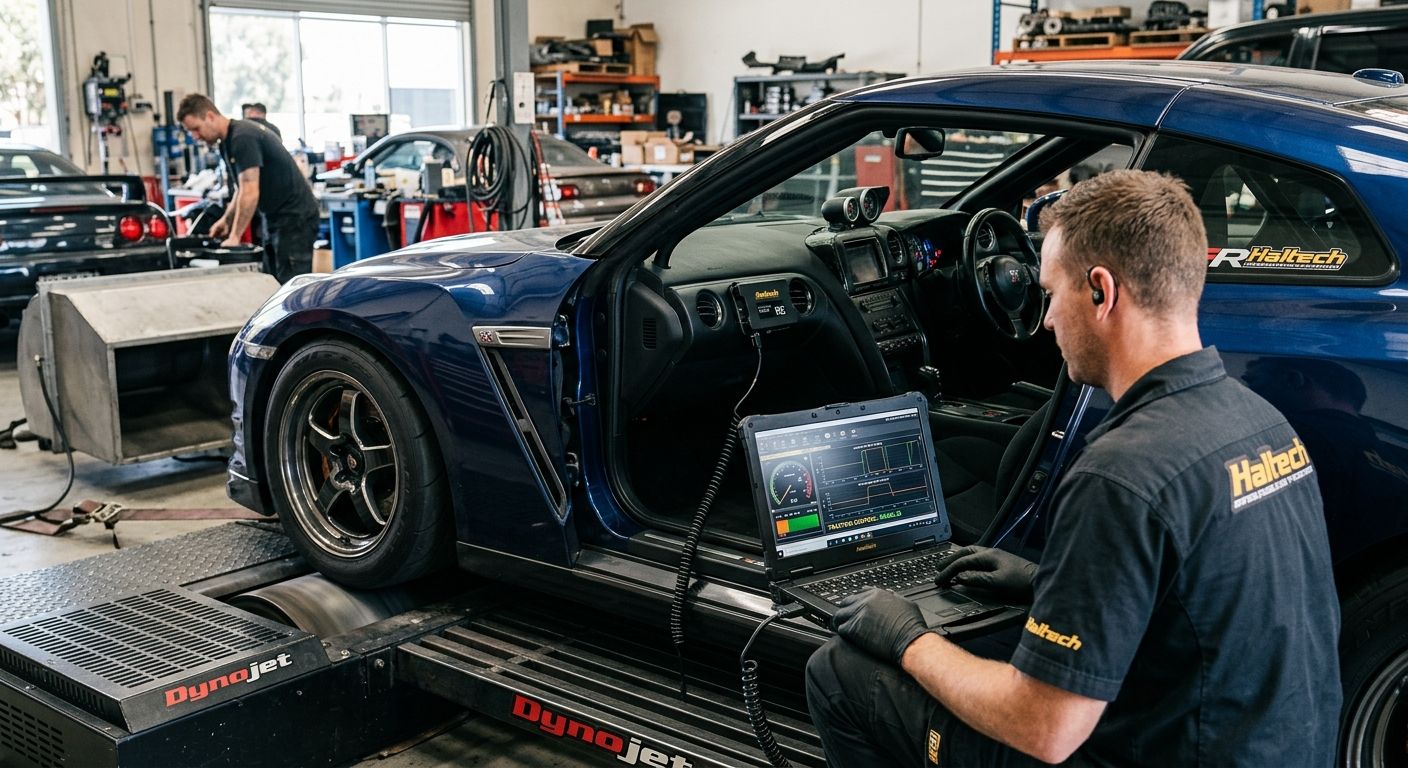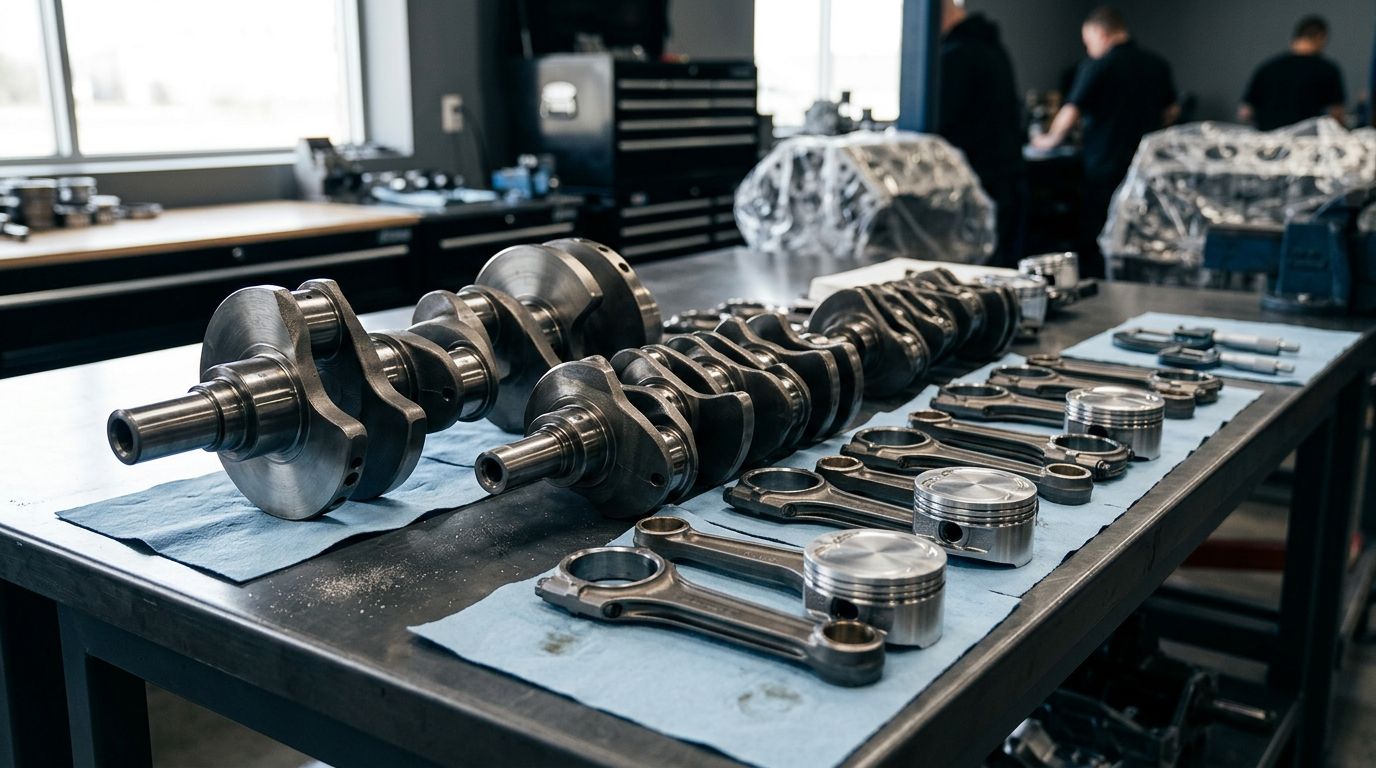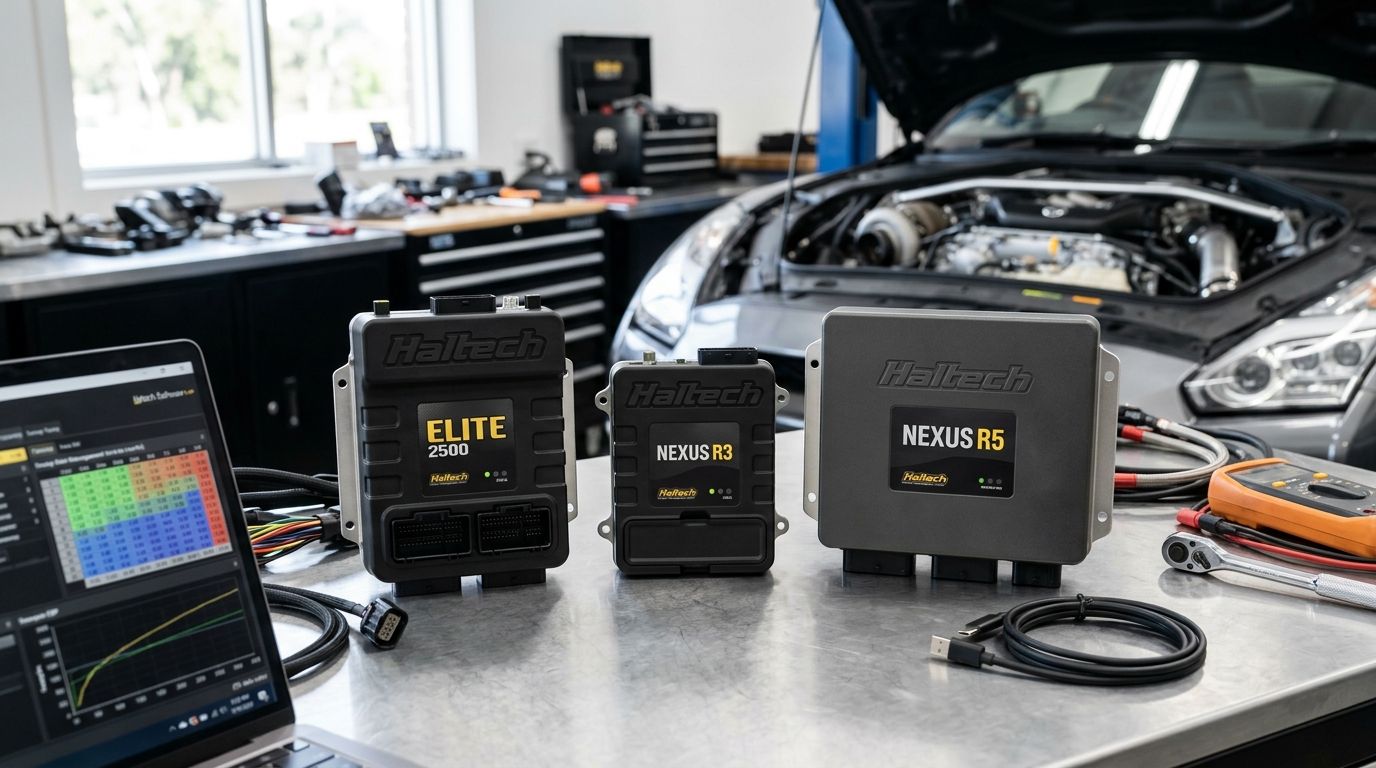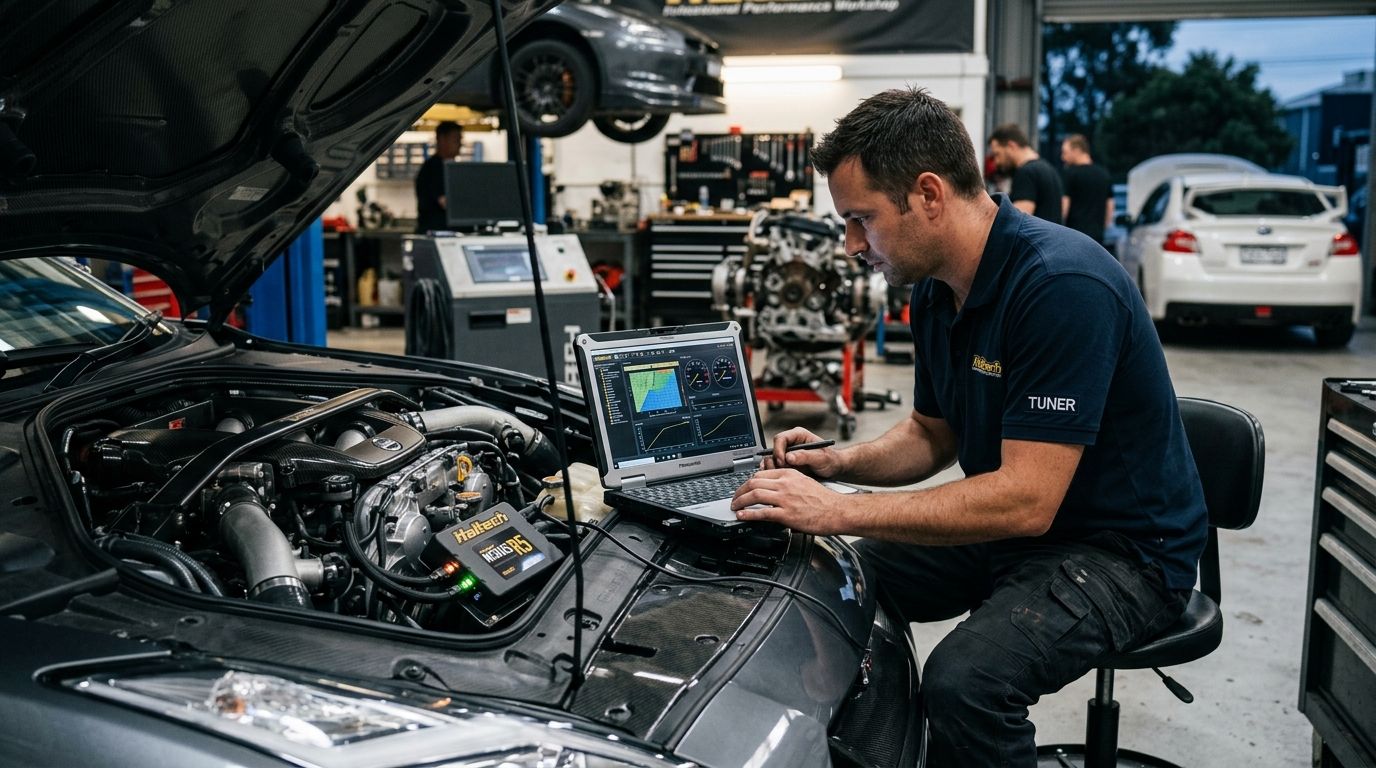
Haltech ECU tuning for performance workshops means selecting, installing and calibrating a standalone engine management system so a shop can control fuel, ignition, boost and safety strategies on customer builds without relying on factory ECU limitations. Workshops need more than a single-car tune: they need a platform that scales across six-cylinder swaps, LS conversions, rotary builds and forced-induction daily drivers, with wiring and logging that hold up to repeat customer jobs.
- Haltech ECU tuning for performance workshops is standalone engine management for repeatable, multi-platform tuning work, not a single-car install.
- Haltech Elite and Nexus series ECUs cover plug-and-play and universal harness jobs; pick the tier by injector count, sensor inputs and platform complexity.
- The Haltech IC-7 dash gives customers live logging access without handing over laptop-based tuning software.
- Workshops that skip a proper base map and knock/boost safety strategy see comebacks, not repeat customers.
- Link G4+ and MoTeC M1 are the main comparison points against Haltech for workshop-grade tuning in 2026.
Why Haltech ECU tuning matters for performance workshops
A workshop's ECU choice determines how many platforms it can quote confidently. Haltech ECU for turbocharged six-cylinder builds covers RB, Barra and 2JZ six-cylinder swaps, which is where most Australian workshops spend their tuning hours in 2026. Getting the ECU tier wrong means either paying for inputs a daily-driven build never uses, or running out of auxiliary outputs halfway through a customer's staged build.
Workshops also carry liability a home tuner doesn't. A comeback on a knock event or a boost overshoot costs a shop its reputation with that customer and everyone they refer. The ECU and the tuning process around it need to be repeatable across staff, not dependent on one tuner's memory.
Audit the platform before you quote the ECU
Before recommending any ECU, confirm what the engine and its supporting components can actually handle.
- Confirm injector size, fuel pump capacity and fuel pressure regulation match the target power figure
- Check turbo compressor and wastegate sizing against the boost target
- Record factory sensor types (cam/crank trigger pattern, knock sensor count, wideband presence)
- Note whether the loom is factory, aftermarket plug-and-play, or fully custom
- Confirm the transmission type if the ECU will handle trans control or launch strategies
Choose the right Haltech ECU tier for the job
Haltech's range splits broadly into plug-and-play and universal wiring ECUs. Workshops running frequent swaps on common platforms lean plug-and-play; workshops handling custom builds need the universal Elite or Nexus units with more configurable inputs and outputs.
- Match input/output count to the number of injectors, coils and auxiliary devices on the build
- Confirm CAN bus support if the build needs a dash, wideband controller or boost controller networked in
- Check whether the platform has an existing plug-and-play harness or needs a full custom loom
- Factor in flex-fuel, traction control or dual-fuel-pump requirements up front, not after wiring is finished
- Keep one ECU family in the shop's toolkit where possible so staff aren't relearning software per job
Wire and install to workshop standard, not one-off standard
A one-off install can get away with shortcuts a repeat-business workshop can't.
- Use heat-shrink and split-loom on every run, labelled at both ends
- Route knock sensor wiring away from ignition leads and alternator cabling
- Fuse and relay every high-current output (fuel pump, fans, injectors) separately
- Mount the ECU away from direct heat and vibration sources in the engine bay
- Document the pinout and connector layout before the loom goes into the car, not after
Base-map and log before the car leaves the workshop
A base map gets the engine running safely; it is not the finished tune.
- Set conservative fuel and ignition maps for cold start and idle first
- Confirm closed-loop lambda targets before opening the throttle beyond light load
- Log knock, AFR and boost on the first dyno pulls in small throttle steps
- Set a hard boost cut and rev limit before any full-throttle run
- Save a dated backup of every map revision, not just the final file
Set up boost control, launch control and safety strategies
This is where a standalone ECU earns its keep over a factory unit.
- Configure closed-loop boost control with a target table by gear and RPM
- Set launch control RPM and a two-step limiter if the customer drag races
- Add a knock-based ignition retard strategy with a hard cut as the backstop
- Configure fuel pressure and lambda-based fuel cuts for pump or lean-out failures
- Set an over-boost cut separate from the target boost table
Give customers dash and logging access without handing over the tune
Customers increasingly want to see live data without a laptop plugged into their car. The Haltech IC-7 dash covers this for track day and street builds, giving the customer boost, AFR, coolant and RPM on one screen while the tune file stays with the workshop.
- Configure the dash pages the customer actually wants (track vs street layout)
- Set warning thresholds on oil pressure, coolant temp and AFR the customer can see
- Keep tune-editing access restricted to workshop laptops, not the customer's phone app
- Log a data session and review it with the customer at handover
- Confirm the dash firmware matches the ECU firmware version before delivery
Document the tune and set a revisit schedule
A tune isn't a set-and-forget job, especially on a build that will see more modifications.
- Record injector data, fuel type and target boost in the customer file
- Note any parts still pending (bigger turbo, standalone dash, fuel system upgrade)
- Set a follow-up interval for E85 blend changes or fuel quality shifts
- Flag any temporary safety margins that need revisiting once supporting parts arrive
- Keep a shop-wide log of which ECU firmware version is running on which customer car
Haltech vs other ECU brands for workshop tuning
Workshops rarely run one ECU brand exclusively. The table below compares the main options a shop will quote against in 2026.
| ECU option | Best for | Key limitation |
|---|---|---|
| Haltech Elite series | Universal wiring on custom six-cylinder and LS swaps | Requires more setup time than a plug-and-play harness |
| Haltech Nexus series | Plug-and-play OEM-connector platforms needing fast turnaround | Fewer configurable inputs than the Elite range on heavily modified builds |
| Link G4+ | Budget-conscious builds where the shop already knows PCLink software | Smaller dealer/support network in Australia compared to Haltech |
| MoTeC M1 | Professional motorsport builds needing advanced data logging | Steeper learning curve and typically reserved for race-only applications |
Verdict: Haltech's Elite and Nexus range covers the bulk of workshop tuning work across six-cylinder swaps and LS platforms in 2026, with Link G4+ as the value alternative and MoTeC M1 reserved for dedicated race cars where its logging depth justifies the added complexity.
Common mistakes performance workshops make with Haltech ECU tuning
- Under-speccing the ECU tier to save on the quote, then hitting an input/output ceiling mid-build when the customer adds a bigger turbo or flex-fuel
- Skipping a proper knock strategy because the base map ran clean on the dyno, then missing a knock event on pump fuel in summer heat
- Not documenting firmware versions across the shop, leading to a technician loading an incompatible map onto a different ECU revision
- Handing over full tune-editing access to the customer instead of dash-only access, then losing control of warranty conversations when the customer changes the map
- Treating the ECU as the whole job instead of confirming injectors, fuel pump and turbo sizing first, which is the step most comebacks trace back to
Talk to Spool Imports about your Haltech build
Get ECU tier and wiring advice before you quote the job.
FAQ
What's the best Haltech ECU for a workshop running multiple platforms?
The Elite series suits workshops running custom or heavily modified builds because it offers the most configurable inputs and outputs. Shops doing frequent OEM-connector swaps on common platforms often run the Nexus series instead for faster turnaround.
Is Haltech better than Link G4+ for workshop tuning?
Haltech has a larger Australian dealer and support network, which matters for workshops needing fast parts and technical backup. Link G4+ remains a valid budget option for shops already trained on PCLink software.
Do I need a dash separate from the ECU for customer builds?
A separate dash like the Haltech IC-7 lets customers see live data without accessing the tune file itself. This keeps tune control with the workshop while still giving the customer boost, AFR and temperature readouts.
How much tuning experience does a workshop need before running Haltech?
Basic fuel and ignition mapping is accessible to a trained technician, but boost control, knock strategies and launch control setups need dedicated tuning experience. Workshops without in-house tuning often partner with an external calibrator for these strategies.
What causes most ECU-related comebacks in workshops?
Missing or overly loose safety strategies, particularly knock-based ignition retard and boost cut settings, account for most comebacks. Under-specced injectors or fuel pumps relative to the tune target are the next most common cause.
Can one Haltech ECU handle both street and track use?
Yes, most Elite and Nexus units support multiple map switching for street and track configurations on the same tune file. The dash and logging setup should reflect whichever mode the customer is running that day.
Does the ECU choice affect fuel system requirements?
The ECU controls the fuel strategy but doesn't change what the fuel system can physically deliver. Injector sizing and fuel pump capacity need to be confirmed against the target power figure before the ECU is configured.
One last thing
The single biggest gap workshops report in 2026 isn't ECU capability, it's firmware and map version control across multiple technicians touching the same customer car. A shared log of ECU firmware, map revision and pending parts per customer file prevents more comebacks than any single wiring or tuning technique on this list.