Haltech's Elite range covers six ECU models, from the four-cylinder Elite 550 through to the flagship Elite 2500, and picking the wrong tier means either paying for input/output capacity you'll never use or running out of outputs halfway through a build. This benchmark lines up cylinder support, tier positioning and best-fit applications by model, so you can match an ECU to the engine you're actually running in 2026, not the one with the biggest number on the box.
- Haltech ECU comparison by model: Elite 550 covers 4-cylinder engines, Elite 2500 is the 8-cylinder flagship with the widest I/O.
- Elite 1000 and Elite 1500 both support V8s, but the 1500 carries more auxiliary output for staged boost control.
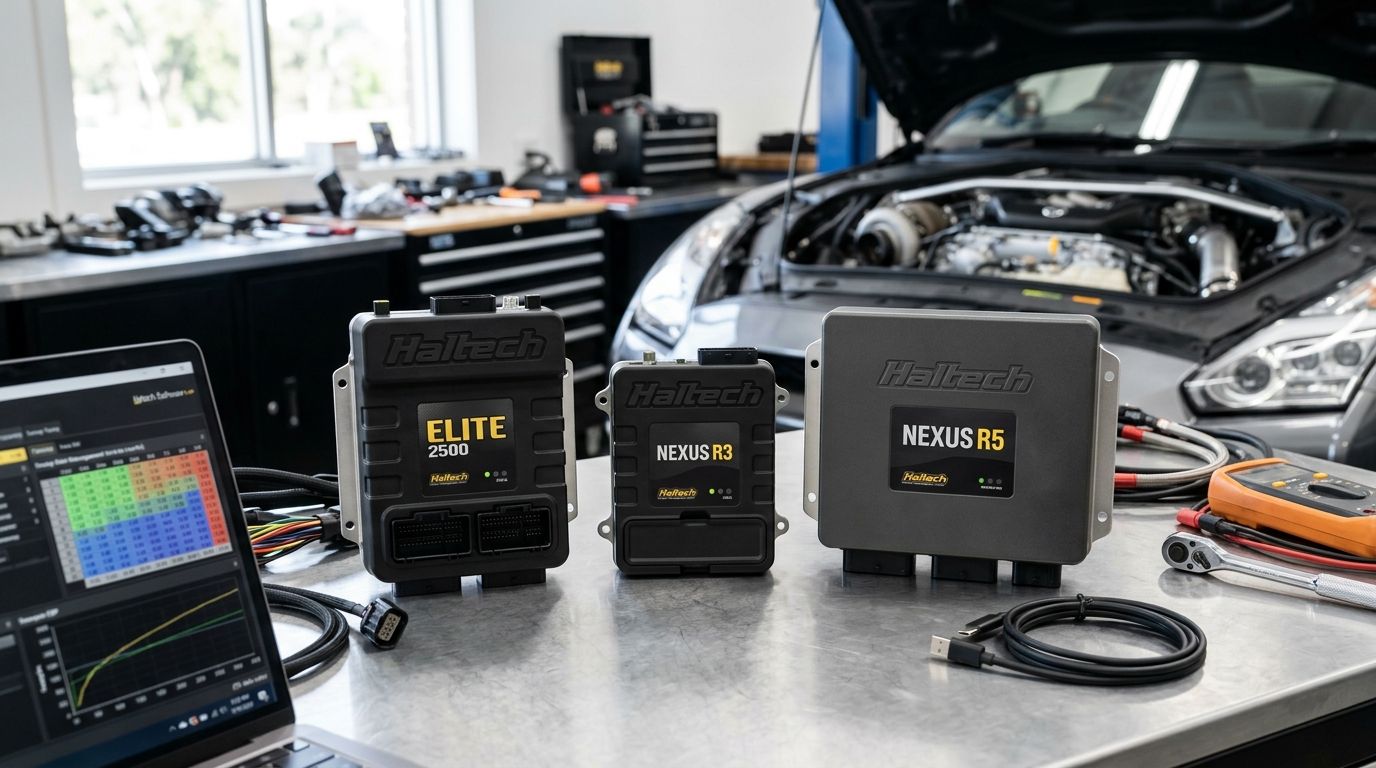
- Nexus R5 is a GT-R specific plug-and-play unit, not a general-purpose Elite-style ECU.
- IC-7 Dash is a display and logger, not a standalone ECU - it pairs with any Elite model.
- Match cylinder count and control complexity first before comparing Haltech against Link, MoTeC or AEM.
Why this matters
Buying ECU headroom you don't need wastes budget that's better spent on the crank trigger kit, injectors or wiring loom that also have to work on day one. Buying too little means the ECU can't run boost-by-gear, launch control or closed-loop fuel once the build grows past its original spec. The Haltech ECU for a turbocharged six-cylinder build selection question comes up daily on RB30, Barra, LS3 and 2JZ platforms, and it always comes down to cylinder count and control list, not brand loyalty.
This page is a specification benchmark, not a hype list. Every model below does its job - the difference is scope, not quality.
Haltech Elite ECU comparison by model
The Elite range spans six models from the four-cylinder Elite 550 up to the flagship Elite 2500, with cylinder support and input/output capacity increasing at each tier. The right pick depends on how many cylinders you're running and how much auxiliary control - boost-by-gear, traction control, closed-loop fuel - your build actually needs.
| Model | Max cylinder support | Tier | Best suited to |
|---|---|---|---|
| Elite 550 | 4-cylinder | Entry-level | Four-cylinder turbo platforms (EJ, 4G63, SR20) run as a standalone replacement |
| Elite 750 | 6-cylinder | Entry-level six | RB25/RB26 and Barra six-cylinder swaps needing sequential fuel and ignition control |
| Elite 1000 | 8-cylinder | Mid-range V8 | LS-based V8 swaps and naturally aspirated to moderate-boost combinations |
| Elite 1500 | 8-cylinder | Mid-range V8, extended I/O | Boosted V8 builds needing more auxiliary outputs than the 1000 offers |
| Elite 2000 | 8-cylinder | Upper-tier | Multi-fuel or driver-aid-heavy builds (launch control, flat-shift) |
| Elite 2500 | 8-cylinder | Flagship | Widest input/output count in the range, for the most complex motorsport builds |
The Elite 550 sits at the bottom of the range on both cylinder count and total I/O capacity - it's built for four-cylinder engines and doesn't carry the auxiliary output count the bigger models do. The Elite 2500 sits at the top, matching the 8-cylinder support of the 1000/1500/2000 tier but with the widest I/O in the Elite lineup, built for combinations running staged boost control, full traction control and closed-loop fuel management at the same time.
These tiers reflect Haltech's current Elite lineup as sold through Australian distributors including Spool Imports in 2026. Exact pin-out and channel counts vary by loom option and firmware version, so confirm the specification for your chosen model against the current datasheet before you commit to a harness design. One limitation worth naming: this table doesn't cover the Nexus series (application-specific plug-and-play units) or the IC-7 Dash (a display and logger, not a standalone ECU) - both sit in a separate product category, covered below.
How to use these benchmarks
- Match cylinder count first, tier second. A four-cylinder engine doesn't need Elite 2500 headroom - buy the 550 or 750 and put the difference into the fuel system.
- Step up a tier if you're running boost-by-gear or launch control together. The Elite 1500 handles more simultaneous auxiliary functions than the 1000; if you're stacking features, don't undersize it. Spool's guide on controlling boost by gear with a Haltech Elite ECU covers what that setup actually needs from the ECU.
- Don't buy flagship I/O for a street car that will never see a dyno day. The Elite 2000 and 2500 earn their place on cars running data-logging-heavy motorsport programs, not weekend cruisers.
- Check platform fit before checking ECU tier. An RB30 stroker build and a Barra 6-cylinder swap both fit in the 750/1000 window, but their auxiliary needs differ once boost and fuelling get involved.
Nexus and IC-7 Dash: not part of this comparison, but often confused with it
Two Haltech products get lumped into ECU comparisons and shouldn't be. The Nexus R5 is a plug-and-play ECU built specifically around the Nissan GT-R wiring and sensor layout - it's not a general-purpose unit you fit to an RB30 or a Barra, and comparing its I/O against the Elite range misses the point of what it's designed for.
The IC-7 Dash isn't an ECU at all. It's a display and data logger that pairs with any Elite model (or most other Haltech-supported ECUs) over CAN, and it's covered in more detail in Spool's guide to the Haltech IC-7 Dash for track day and street builds. If you're shopping for engine control, the IC-7 doesn't factor into the decision - it's an add-on once the ECU choice is made.
How Haltech Elite compares to other standalone ECU brands
Haltech isn't the only standalone ECU platform Australian workshops fit. Link G4X, MoTeC M1 and AEM Infinity all cover similar tiers of programmable engine control, and the choice between them usually comes down to dealer support, tuning software preference and loom availability rather than a single spec sheet.
| ECU platform | Typical positioning | Best for | Verdict |
|---|---|---|---|
| Haltech Elite | Entry to flagship, 4 to 8-cylinder | Street and workshop tuning with wide Australian dealer support | Buy - broad platform coverage and local parts support |
| Link G4X | Similar spread, plug-in and universal wire-in options | Builds wanting a wire-in loom with a straightforward tuning interface | Consider - strong option for universal wire-in swaps |
| MoTeC M1 | Motorsport-focused, upper-end pricing tier | Professional race teams needing deep data acquisition | Consider - more capability than most street builds use |
| AEM Infinity | Universal wire-in, mid-to-upper tier | US-market swap platforms (LS, Coyote) | Consider - check local tuner familiarity before buying |
None of these are wrong choices. The Elite 1500 is the practical minimum for a boosted V8 running staged boost control and launch control together, not the Elite 1000 - that's the kind of distinction that matters more than which badge is on the box.
“The Elite 1500 is the practical minimum for a boosted V8 running staged boost control and launch control together, not the Elite 1000.”
Wiring and tuning support once the ECU is chosen
An Elite ECU is only as good as the trigger signal and fuel feedback it gets. A mismatched crank trigger kit causes false readings under load, and running an open-loop tune without wideband feedback leaves fuelling guesswork in place long after the ECU is installed.
Need a crank trigger kit for your Haltech install?
Match trigger hardware to your Elite ECU before you wire the harness.
FAQ
What's the difference between Haltech Elite 1000 and Elite 1500?
Both support 8-cylinder engines, but the Elite 1500 carries more auxiliary input/output capacity than the Elite 1000. Choose the 1500 if your build stacks features like staged boost control and launch control together.
Is the Haltech Elite 2500 overkill for a street car?
For most street builds, yes. The Elite 2500 carries the widest I/O in the range, built for motorsport programs running heavy data-logging and multiple driver-aid systems, not a daily-driven turbo six.
Can the Elite 550 run a six-cylinder engine?
No. The Elite 550 is built for 4-cylinder engines; a 6-cylinder platform like RB25 or Barra needs the Elite 750 or higher.
What ECU pairs with the Haltech IC-7 Dash?
The IC-7 Dash is a display and logger, not an ECU itself, and pairs with any Elite model over CAN. It doesn't replace ECU selection - it's an add-on once the ECU is chosen.
Is the Nexus R5 a full standalone ECU?
Yes, but it's application-specific - built around the Nissan GT-R wiring and sensor layout rather than a general-purpose fitment like the Elite range.
How does Haltech Elite compare to Link G4X for a V8 swap?
Both cover similar tiers of programmable control for V8 platforms; the practical difference usually comes down to loom preference and local tuner familiarity rather than a fixed spec gap.
Do I need a wideband controller with an Elite ECU?
For closed-loop fuel tuning, yes - the Elite range needs a wideband input to run closed-loop correction rather than open-loop fuelling alone.
What crank trigger kit works with a Haltech Elite install?
Trigger kit selection depends on your crank and reluctor setup, not the ECU model - confirm the trigger pattern matches what the Elite firmware supports before wiring the harness.
One last thing
The IC-7 Dash gets mistaken for an ECU more often than any other product in the Haltech catalogue - it isn't one. If your build already runs an Elite ECU and you're chasing better on-dash data, the IC-7 is the add-on; if you haven't picked an ECU yet, start with cylinder count and control list, not the dash.