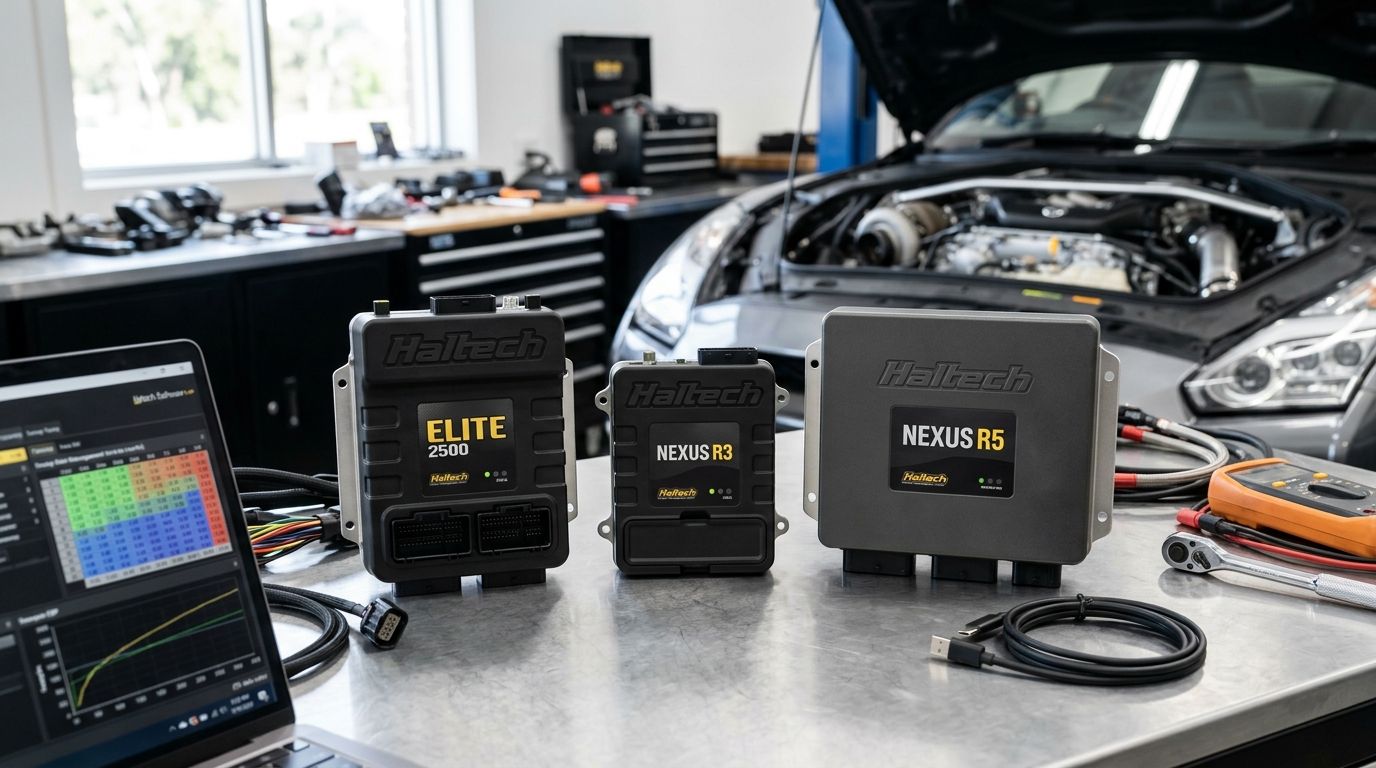
Best overall: Haltech Elite 2500. Best for direct-fit RB and 2JZ swaps: Haltech Elite 2500 T6. Best for expandable, high-power six-cylinder builds: Haltech Nexus R5. Best budget entry point into the Elite ecosystem: Haltech Elite 1500.
- The Haltech Elite 2500 is the best Haltech ECU for a turbo six cylinder build that needs full sequential control with room to grow.
- The Elite 2500 T6 is the pick for RB25, RB30 and 2JZ swaps where a terminated, plug-style harness saves wiring time.
- The Nexus R5 suits high-power six-cylinder builds that will keep adding sensors, drive-by-wire or extra outputs over time.
- The Elite 1500 is the entry point for a straightforward turbo six that doesn't need every channel the 2500 offers.
- Match the ECU to injector/ignition output count and harness availability before comparing feature lists.
Why this matters
A turbo six-cylinder swap lives or dies on how well the ECU matches the engine, not on which brand looks best in a forum thread. RB25, RB30, 1JZ-GTE, 2JZ-GE/GTE, Barra and TB48 platforms all run six injector and six ignition events per cycle, and the ECU needs enough outputs to fire them sequentially rather than in batches.
Getting this wrong shows up as flat torque delivery, poor idle quality, or a tuner charging extra hours to work around a hardware limitation. If you're planning an RB30 build, the ECU decision should happen before the wiring loom does, not after.
This guide ranks four Haltech ECU platforms against the criteria that actually matter for a turbo six build in 2026: output count, harness availability, expansion room and tuning support.
What makes the best Haltech ECU for a turbo six cylinder build
- Injector and ignition output count matched to full sequential control across six cylinders, not shared batch outputs.
- Plug-and-play or terminated harness availability for the specific engine platform, cutting wiring labour on a swap.
- Expansion capacity for closed-loop boost control, flex fuel, drive-by-wire and extra sensor inputs as the build grows.
- CAN-bus integration with dash displays and peripheral controllers rather than analogue-only gauge feeds.
- Tuning software depth and access to closed-loop wideband control without extra hardware.
- Local support and tuning file availability through the Australian Haltech dealer and tuner network.
Haltech ECU options for turbo six cylinder builds at a glance
| ECU | Best for | Standout feature | Key limitation |
|---|---|---|---|
| Haltech Elite 2500 | Turbo six builds overall | Full sequential fuel and ignition with headroom to eight cylinders | Requires a custom or piggyback harness on most platforms |
| Haltech Elite 2500 T6 | Direct-fit RB and 2JZ swaps | Terminated, factory-style connector kit for select platforms | Only available where a terminated kit exists for your engine |
| Haltech Nexus R5 | Expandable, high-power six builds | CAN-based architecture with plug-in I/O expansion boxes | More ECU than a simple street swap usually needs |
| Haltech Elite 1500 | Entry-level six cylinder turbo builds | Sequential control on four- and six-cylinder engines at a lower channel count | Fewer spare outputs for future accessories than the 2500 |
1. Haltech Elite 2500: best Haltech ECU for a turbo six cylinder build overall
The Elite 2500 is Haltech's mid-to-upper Elite platform, built to run full sequential fuel and ignition on engines up to eight cylinders, which gives a turbo six plenty of spare capacity. It handles closed-loop boost control, flex fuel and drive-by-wire throttle without needing an add-on module, which matters once a build moves past basic tuning.
For RB30, Barra or 2JZ combinations aiming at serious power, the extra channel count means auxiliary outputs stay available for things like staged injection or a second wideband down the track.
Haltech Elite 2500 pros:
- Full sequential fuel and ignition control across six cylinders with room to spare
- Built-in closed-loop boost, flex fuel and drive-by-wire support
- CAN-bus compatible with Haltech dash and expansion hardware
- Wide tuner familiarity across Australian workshops
Haltech Elite 2500 pros and cons — Elite 2500 cons:
- No terminated plug-in harness for most platforms, so wiring labour is part of the job
- More capability than a mild street six-cylinder build strictly needs
Best for: turbo six-cylinder builds where you want headroom for future upgrades without changing ECUs later. Verdict: Buy.
2. Haltech Elite 2500 T6: best Haltech ECU for a direct-fit RB and 2JZ swap
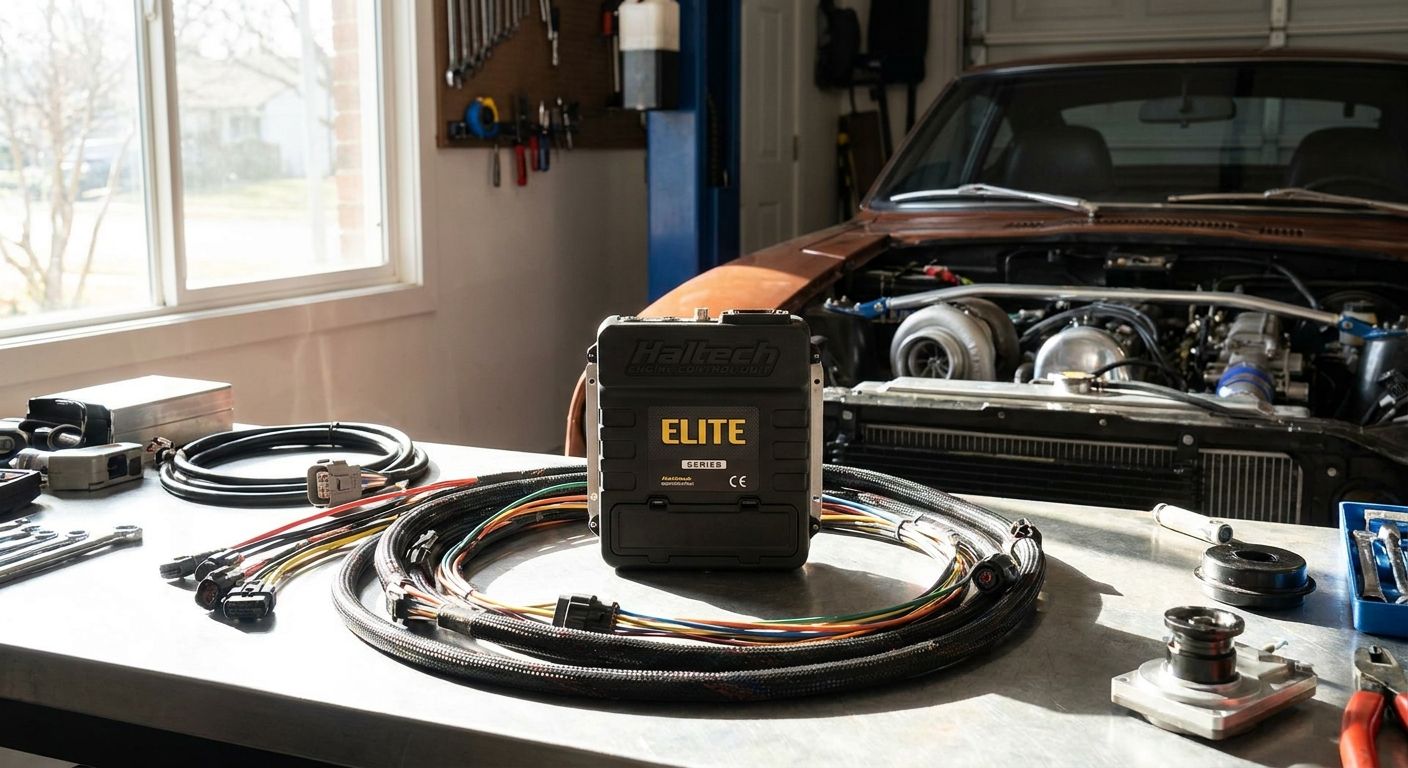
The Elite 2500 T6 is the terminated harness version of the same Elite 2500 hardware, built with factory-style connectors for specific six-cylinder platforms including Nissan RB and Toyota JZ applications. It removes most of the custom wiring work that a bare Elite 2500 requires, which shortens install time on a swap.
It runs the same sequential fuel, ignition and boost control feature set as the standard 2500 — the difference is entirely in the connector and harness, not the ECU's capability.
Haltech Elite 2500 T6 pros:
- Terminated, plug-style harness cuts wiring time on supported platforms
- Same sequential control and feature set as the standard Elite 2500
- Reduces wiring errors compared with a fully custom loom
Elite 2500 T6 cons:
- Only available where Haltech has released a terminated kit for that specific platform
- Less flexible than a bare ECU if the engine bay layout has been heavily modified
Best for: RB25, RB30 and 2JZ swaps where minimising wiring labour matters as much as the tune. Verdict: Buy for supported platforms.
3. Haltech Nexus R5: best Haltech ECU for a high-power, expandable six cylinder build
The Nexus R5 runs Haltech's newer CAN-based architecture, using plug-in I/O expansion boxes to add channels rather than being fixed at a set output count out of the box. That makes it the platform to pick when a six-cylinder build is going to keep growing — more sensors, staged fuel systems, or additional peripheral control over several seasons.
It suits builds where the engine combination isn't finalised yet, or where a shop wants one ECU platform that scales from a street six to a full race combination.
Haltech Nexus R5 pros:
- Expandable through CAN-based I/O boxes instead of a fixed channel count
- Suited to builds that will keep adding hardware over time
- Shares Haltech's tuning software and CAN ecosystem with the Elite range
Nexus R5 cons:
- More ECU and more setup than a straightforward street six-cylinder swap needs
- Expansion boxes add cost and complexity to the initial install
Best for: high-power six-cylinder builds — including 1000hp Barra combinations — that need to scale without a full ECU change later. Verdict: Buy for builds planned to grow.
4. Haltech Elite 1500: best Haltech ECU for an entry-level six cylinder turbo build
The Elite 1500 sits below the 2500 in Haltech's Elite range, handling sequential fuel and ignition on four- and six-cylinder engines without the extra output count built into the larger unit. For a mild turbo six that isn't chasing flex fuel, drive-by-wire or staged injection, it delivers the same core sequential control at a lower channel count.
It's a reasonable starting point for a daily-driven six-cylinder swap or a first turbo build where the feature list of the 2500 goes largely unused.
Haltech Elite 1500 pros:
- Full sequential fuel and ignition on six-cylinder engines
- Lower channel count keeps the install simpler
- Shares Haltech's tuning software with the rest of the Elite range
Elite 1500 cons:
- Fewer spare outputs than the 2500 for future accessories
- Not the right choice once flex fuel, drive-by-wire or staged injection are on the plan
Best for: a straightforward turbo six build without an expanding feature list. Verdict: Buy for basic builds, Wait if you already know you want flex fuel or drive-by-wire.
How Haltech compares to other ECU brands for six cylinder builds
Link G4X and MoTeC M1 both show up regularly on RB, 2JZ and Barra swaps in Australia, and both are capable of running a fully sequential turbo six. The practical difference for most workshops is harness availability and local tuner familiarity — Haltech's terminated kits for RB and JZ platforms, plus its CAN-bus dash and I/O ecosystem, mean fewer custom parts sourced from overseas and more tuners already comfortable with the software.
“On an RB25 or 2JZ swap, a terminated harness like the Elite 2500 T6 saves more build time than any single feature on the spec sheet.”
How we ranked these Haltech ECUs
Ranking here comes down to output count against a six-cylinder sequential requirement, harness availability for common Australian swap platforms, CAN-bus expansion for dash and peripheral hardware such as the IC-7 dash, and how much room each platform leaves for adding features later without a hardware change.
Need help matching an ECU to your engine
Talk through your platform, power target and harness before you buy.
Which Haltech ECU should you choose?
If you're not sure where to start, the Haltech Elite 2500 is the safest default for a turbo six cylinder build in 2026 — it covers sequential control, boost management and flex fuel without forcing a second purchase later. Drop to the Elite 1500 if the build stays simple and the budget matters more than headroom.
Going onto an RB25, RB30 or 2JZ platform with an existing terminated kit, the Elite 2500 T6 removes the wiring guesswork. Planning a build that will keep growing over several seasons, the Nexus R5 is built for exactly that scenario, including combinations similar to the RB25det rebuild covered here.
FAQ
What is the best Haltech ECU for a turbo six cylinder build?
The Haltech Elite 2500 is the best overall pick for a turbo six cylinder build in 2026 because it runs full sequential fuel and ignition with headroom for future upgrades. Budget-focused builds without flex fuel or drive-by-wire needs are well served by the smaller Elite 1500.
Is the Haltech Elite 2500 better than the Elite 1500 for a six cylinder engine?
The Elite 2500 offers more output channels and built-in features like closed-loop boost and flex fuel, which the Elite 1500 does not include. For a simple street six without those extras, the Elite 1500 still runs full sequential control on six cylinders.
Does Haltech make a plug-and-play ECU for RB25 or RB30 engines?
Haltech offers the Elite 2500 T6 as a terminated harness kit for select Nissan RB platforms, which uses factory-style connectors instead of a fully custom loom. Availability depends on the exact engine and chassis combination.
What's the difference between Haltech Elite and Nexus ECUs?
The Elite range uses a fixed channel count per model, while the Nexus R5 uses a CAN-based architecture that expands through plug-in I/O boxes. Nexus suits builds expected to keep adding hardware over time.
Can a Haltech ECU run a turbo 2JZ or 1JZ engine?
Yes, the Elite 2500, Elite 2500 T6 and Nexus R5 all support turbo 2JZ and 1JZ applications with sequential fuel and ignition control. The 2500 T6 is available with a terminated harness for select JZ platforms.
Do I need the Elite 2500 T6 or the standard Elite 2500?
Choose the Elite 2500 T6 if a terminated kit exists for your exact platform, since it saves wiring time with factory-style connectors. Choose the standard Elite 2500 if your engine bay has been modified enough that a custom harness is required anyway.
How much tuning is required after installing a Haltech ECU?
Any standalone ECU, Haltech included, needs a proper dyno or road tune after installation to set fuel, ignition and boost tables correctly. This applies equally to the Elite and Nexus ranges.
Is a Haltech Sprint ECU enough for a turbo six cylinder swap?
The Sprint series is built for simpler, lower-channel applications and isn't the natural fit for a fully sequential turbo six-cylinder build. The Elite or Nexus range gives the output count and expansion room that a turbo six typically needs.
One last thing
The detail that catches people out on a six-cylinder swap isn't the ECU spec sheet — it's whether a terminated harness exists for their exact chassis. Check platform-specific kit availability before locking in a model, because the difference between the Elite 2500 and the Elite 2500 T6 is entirely about the connector, not the ECU's capability.