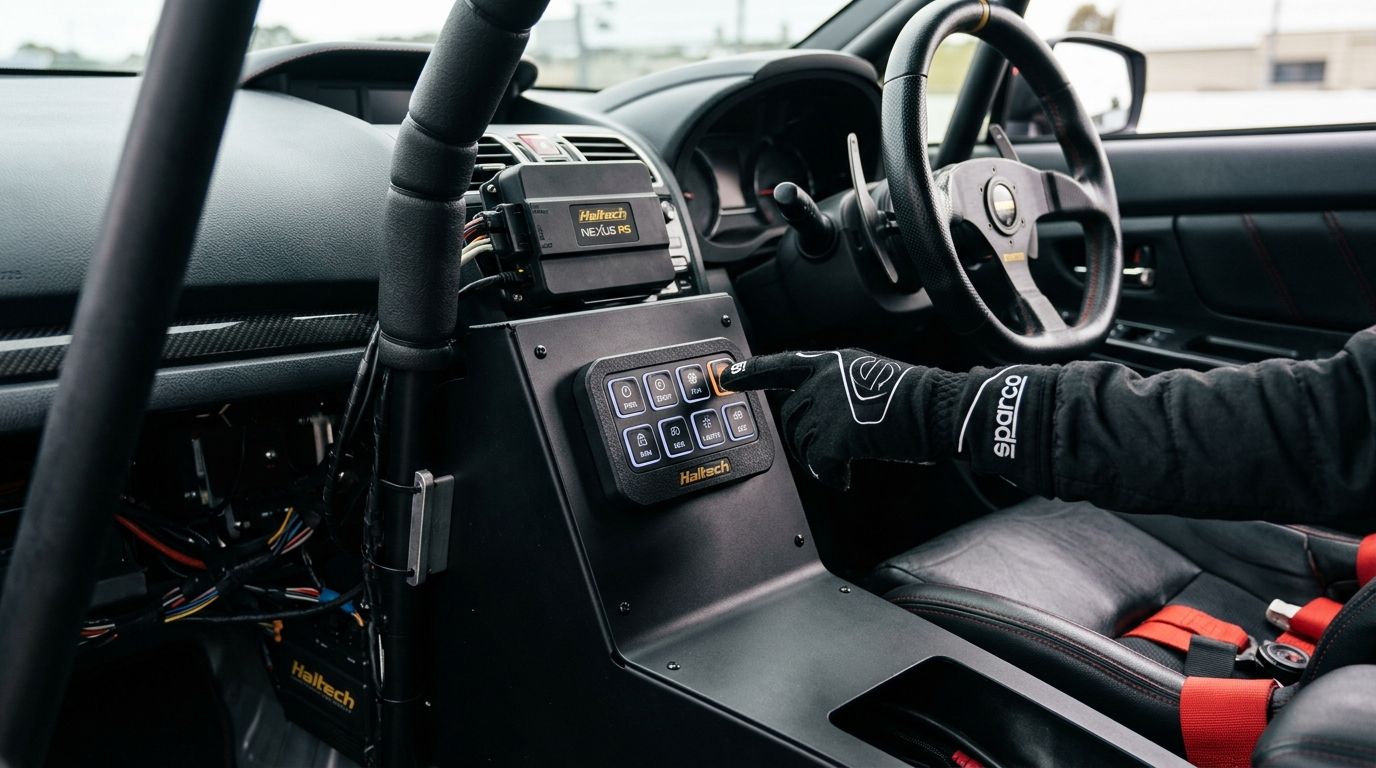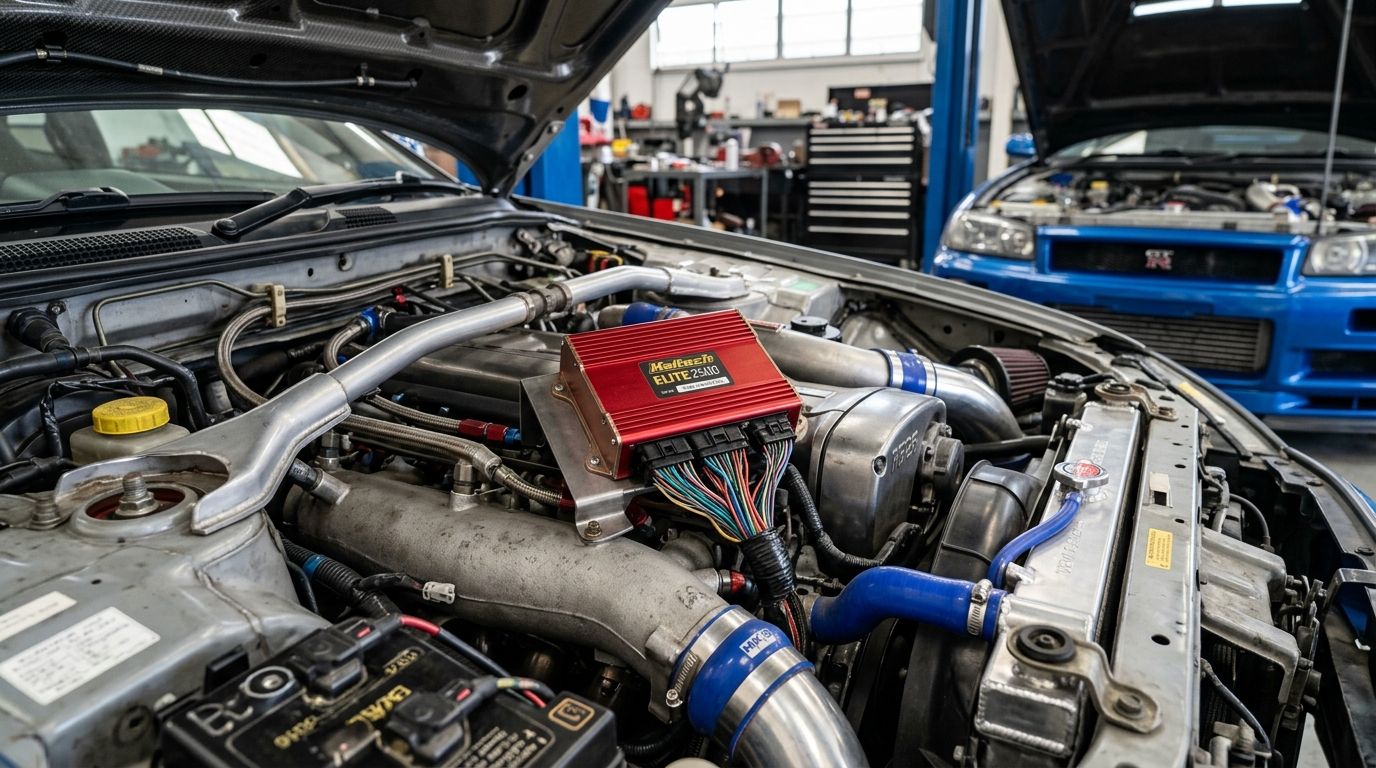
The Haltech Elite 2500 is worth it in 2026 for turbocharged six-cylinder and V8 builds that need full sequential fuel and ignition control, boost control by gear and closed-loop wideband tuning from one standalone box. It's not worth it on a mild naturally aspirated engine or a Barra/N54 turbo upgrade that a factory-based tune already covers — an Elite 1500 or a piggyback solution does that job with less complexity. The cost most buyers underestimate isn't the ECU itself: it's the wiring harness, sensor kit and dyno tuning time that sit on top of it, and that stack usually costs more than the ECU by the time the car is running.
- Haltech Elite 2500 worth it in 2026 for sequential-fuel turbo six-cylinder and V8 builds needing full closed-loop control.
- Elite 1500 or Elite 1000 covers simpler combinations for less complexity and lower total spend.
- Elite 2500 runs boost control by gear, traction control and datalogging from one standalone unit.
- Wiring harness, sensor kit and dyno time sit outside the ECU price and are usually the bigger part of the project.
- Elite 2500T adds extra dedicated outputs for staged boost solenoid setups on more complex turbo systems.
Why this matters
Standalone engine management only earns its keep when the factory ECU or a lower-tier unit runs out of headroom. Haltech's Elite range is tiered by I/O and control complexity, not just badge — jumping straight to the top model because it's the flagship is how workshops overspend on channels they'll never wire up.
Spool Imports stocks the full Haltech Elite range for Australian workshops and engine builders, and the question that comes up constantly is whether the Haltech ECU for turbocharged six-cylinder builds needs to be an Elite 2500 or whether a smaller unit in the range does the job. The honest answer depends on how many functions you're asking the ECU to run at once, not how much power the engine makes.
Is a Haltech Elite 2500 worth it in 2026?
The Elite 2500 sits at the top of Haltech's non-Nexus Elite lineup, built for combinations that need the most inputs, outputs and control functions running simultaneously — not just the biggest number on the box. Compare it against the rest of the Elite range before committing:
| Model | Best for | Verdict |
|---|---|---|
| Elite 750 | Entry-level 4-cylinder swaps, basic fuel/ignition control | Skip for six-cylinder or V8 turbo builds |
| Elite 1000 | Straightforward turbo six-cylinder or V8 with standard sequential control | Buy for simple turbo swaps |
| Elite 1500 | Turbo six-cylinder/V8 needing closed-loop boost and traction control | Buy for most street/strip builds |
| Elite 2500 | High-output six-cylinder or V8 builds needing the widest I/O count and control functions | Buy for complex or motorsport-spec builds |
| Elite 2500T | Elite 2500 platform plus dedicated outputs for staged boost solenoids | Buy when running multi-stage boost control |
The full spec breakdown by model, including what each tier actually adds over the one below it, is covered in the Haltech ECU specs benchmark by model — worth reading before you order rather than after.
Elite 2500: who it actually suits in 2026
The Elite 2500 makes sense on builds where the ECU is doing more than fuel and spark:
- Turbo six-cylinder swaps (RB30, Barra, 2JZ) running sequential fuel and ignition beyond what a factory-based tune or entry Elite model supports.
- V8 swaps that need closed-loop boost control by gear, traction control and datalogging handled by one unit instead of three separate modules.
- Workshops building complex combinations with more sensors, outputs and control functions than a factory ECU or an Elite 1000/1500 has channels for.
- Motorsport-spec builds where lap timing, boost-by-gear and staged control functions all need to talk to the same ECU without workarounds.
If the build fits one of those categories, the Elite 2500 is the correct call in 2026, not an upsell.
Where the Elite 2500 doesn't make sense
- Naturally aspirated street engines with basic tuning needs — the extra I/O sits unused and adds nothing to the outcome.
- Barra or N54 platforms on a mild turbo upgrade where a factory-based retune already covers the target power and drivability.
- Budget builds where an Elite 1000 or Elite 1500 covers every function the combination actually needs.
- First-time standalone installs where the extra complexity of a top-tier unit adds tuning time without adding capability the build will use.
Buying more ECU than the combination needs doesn't make the engine safer — it just adds unused channels and a longer tuning session.
Why the total Elite 2500 project cost varies
The ECU is one line item. What actually moves total project cost:
- Harness type — plug-and-play loom for a supported platform versus a full custom harness for an unsupported swap.
- Sensor package — crank trigger and cam sync setup, wideband controller, boost solenoids and any extra pressure/temp sensors the build calls for.
- Dash and display integration — whether the build runs a separate dash or feeds data through the ECU's own logging.
- Dyno tuning time — more control functions mean more time on the dyno to calibrate them properly.
- Installer labour — workshop rates for wiring, mounting and commissioning vary and usually outweigh the ECU cost itself.
A correctly wired crank trigger kit for a Haltech ECU install affects tuning quality more than which Elite tier sits in the box — a noisy trigger signal will make even a top-tier ECU misbehave.
Browse the Haltech Elite range
Compare Elite tiers before locking in your build spec.
Is the Haltech Elite 2500 plug-and-play for a Barra swap?
The Elite 2500 is not automatically plug-and-play on a Barra swap — that depends on whether a supported harness exists for the specific application, not the ECU tier itself. A correctly specified crank trigger and cam sync setup matters more to a clean start-up than which Elite model is fitted.
Do I need the Elite 2500T instead of the standard Elite 2500?
The Elite 2500T adds dedicated outputs for staged boost solenoids on top of the standard Elite 2500 platform. If the build runs a single boost solenoid and standard boost control, the base Elite 2500 covers it; multi-stage boost control is where the 2500T earns its place.
Can the Elite 2500 run closed-loop fuel control out of the box?
The Elite 2500 supports closed-loop fuel control when paired with a wideband controller — it isn't a function that runs on its own without the hardware feeding it data. Closed-loop fuel tuning with a Haltech WBC1 covers exactly how that pairing works and what it corrects for.
FAQ
Is the Haltech Elite 2500 worth it in 2026?
Yes, for turbocharged six-cylinder and V8 builds running sequential fuel and ignition, boost control by gear and closed-loop tuning from one unit. On a mild or naturally aspirated engine, a lower Elite tier or a factory-based tune covers the same result for less.
What's the difference between the Haltech Elite 1500 and Elite 2500?
The Elite 1500 handles closed-loop boost and traction control for most street and strip turbo builds, while the Elite 2500 adds the widest I/O count in the range for combinations running more sensors and control functions at once.
Does the Haltech Elite 2500 need a custom wiring harness?
It needs a custom harness unless the platform has a supported plug-and-play loom available. Harness type is one of the biggest variables in total project cost, separate from the ECU itself.
Can the Haltech Elite 2500 run traction control?
Yes, traction control is a built-in function on the Elite 2500, alongside boost control by gear and full datalogging, without needing a separate module.
Is the Haltech Elite 2500 overkill for a mild Barra turbo build?
Yes, for a mild Barra turbo upgrade where a factory-based tune already covers the target power. An Elite 1000 or Elite 1500 covers the same tuning range with fewer unused channels.
What's the difference between the Haltech Elite 2500 and 2500T?
The Elite 2500T adds dedicated outputs for staged boost solenoids on top of the standard Elite 2500. Single-solenoid boost control doesn't need the T variant.
Does the Haltech Elite 2500 come with a wideband sensor?
Closed-loop fuel tuning on the Elite 2500 requires a wideband controller such as the Haltech WBC1 paired to it — the ECU handles the logic, the controller supplies the reading.
One last thing
A top-tier Elite 2500 tuned on a poorly grounded harness or a noisy crank trigger signal will misfire, log garbage data and frustrate the tuner more than a correctly wired Elite 1000 ever would. Spool Imports technical staff see more tuning problems traced back to trigger signal and grounding than to ECU tier — spend the time on the harness before upgrading the box.