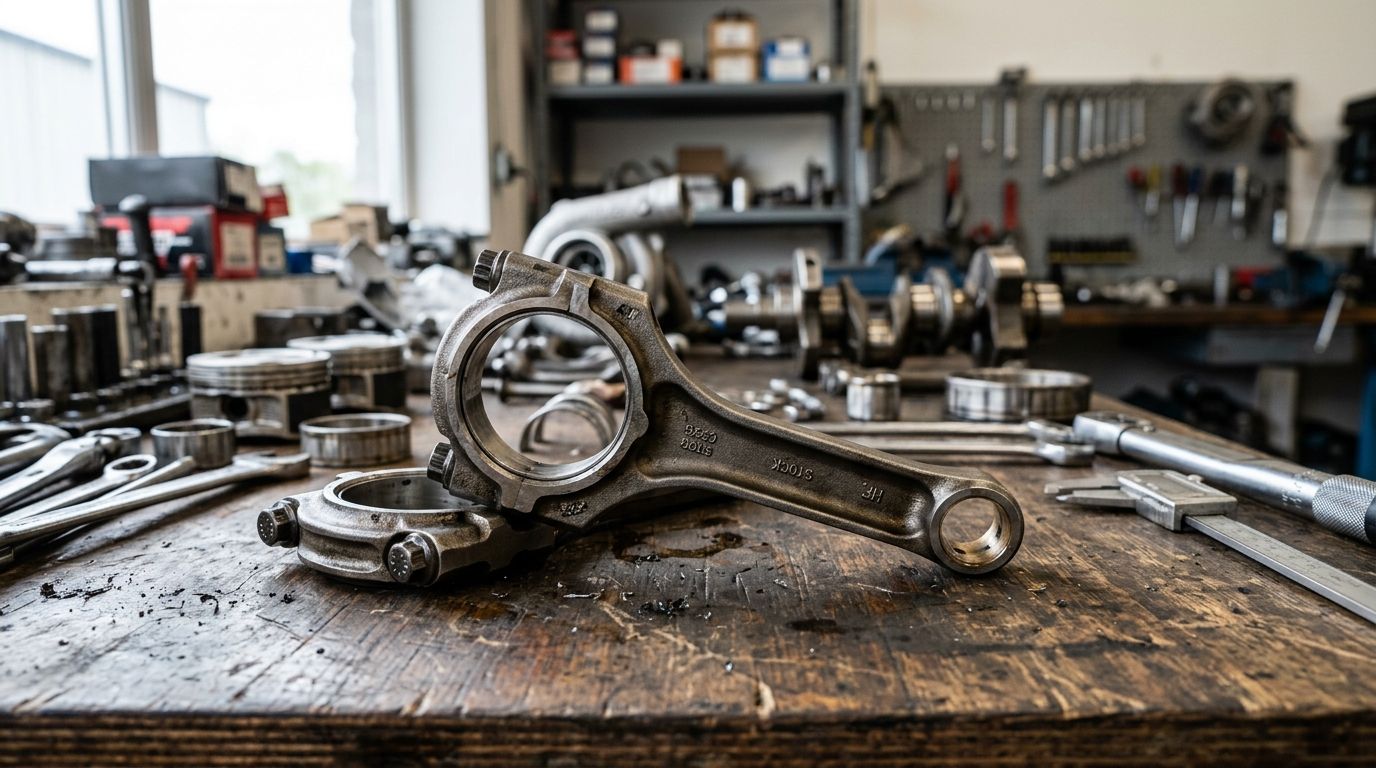
Stock connecting rods on most factory turbocharged engines start showing failure risk once boost pressure climbs past roughly 15 psi, with the realistic safe range sitting between 8 and 20 psi depending on rod material, rod bolt design and tune quality. The number that actually kills a stock rod isn't boost on its own — it's cylinder pressure from detonation, a lazy tune or a factory rod bolt that was never rated for the load being asked of it.
- Stock conrods generally hold 8-20 psi depending on material — cast rods fail earliest, forged factory rods go furthest.
- Rod bolts fail before the rod beam bends in most stock-rod boost failures.
- Detonation from a poor tune drops the safe boost ceiling faster than raising boost pressure alone.
- Once a build targets sustained high boost or E85 power levels, aftermarket forged conrods replace the guesswork with a rated component.
Why this matters
Most engine builders spend their upgrade budget on the turbo, injectors and a tune before checking whether the factory conrods can survive the power level they're chasing. That's backwards. A conrod failure at speed takes the block, the crank and sometimes the head with it — a far bigger bill in 2026 than the cost of a matched aftermarket rod set fitted at the same time as the turbo.
Spool Imports fields this question constantly from workshops upgrading turbocharged sixes and fours where the factory rod was never designed around the power the customer now wants. The honest answer depends on what the rod is actually made of, not just what boost number is dialled into the ECU.
How much boost can stock conrods handle?
The table below groups factory conrods by construction, since that's what actually sets the ceiling — not the engine badge on the rocker cover.
| Rod construction | Typical boost ceiling | Common failure point | Verdict |
|---|---|---|---|
| Cast rods | 8-12 psi | Big-end stretch, bolt failure | Replace before adding boost |
| Powder metal rods | 12-18 psi | Bolt fatigue under detonation | Marginal past factory boost |
| Forged factory rods | 18-25 psi | Bolt fatigue at sustained high RPM | Holds longer, still finite |
These are working ranges from broadly observed patterns across factory turbo platforms, not a guaranteed number for any single engine — a forged pistons and conrods guide is a better reference once you're speccing a rebuild against a specific power target rather than guessing.
Cast rods: 8-12 psi is the realistic ceiling
Cast conrods show up in older engines that were never designed with forced induction in mind, and in some budget-spec factory turbo units. Cast iron and cast steel rods have the least tensile strength and the least tolerance for detonation of the three groups, so the failure window opens early and closes fast once boost climbs past single digits on a worked combination. Verdict: replace, don't run — the margin for error is too thin to justify the risk in 2026.
Powder metal rods: 12-18 psi before margins shrink
Powder metal rods are common across 2000s-era factory turbo fours and sixes and sit in the middle of the strength range. They'll generally tolerate mild boost increases on a clean tune, but the rod bolts — not the beam — are usually the first thing to give up once cylinder pressure spikes from detonation or an aggressive ignition curve. Verdict: workable for mild gains, risky beyond that without a bolt upgrade.
Forged factory rods: 18-25 psi, but still finite
A handful of factory turbo engines, including some six-cylinder platforms like Ford's Barra, left the factory with a stronger forged rod rather than cast or powder metal. These hold up longer under increased boost and have a better track record on largely stock internals, but they're still a finite component — sustained high RPM and repeated detonation events will eventually find the weak point in the bolt or the big-end. Verdict: the strongest of the three, not bulletproof.
Why the boost ceiling varies so much
Boost pressure alone doesn't tell the whole story — these are the factors that actually move the number up or down:
- Rod bolt type and clamping force — the bolt almost always fails before the rod beam bends
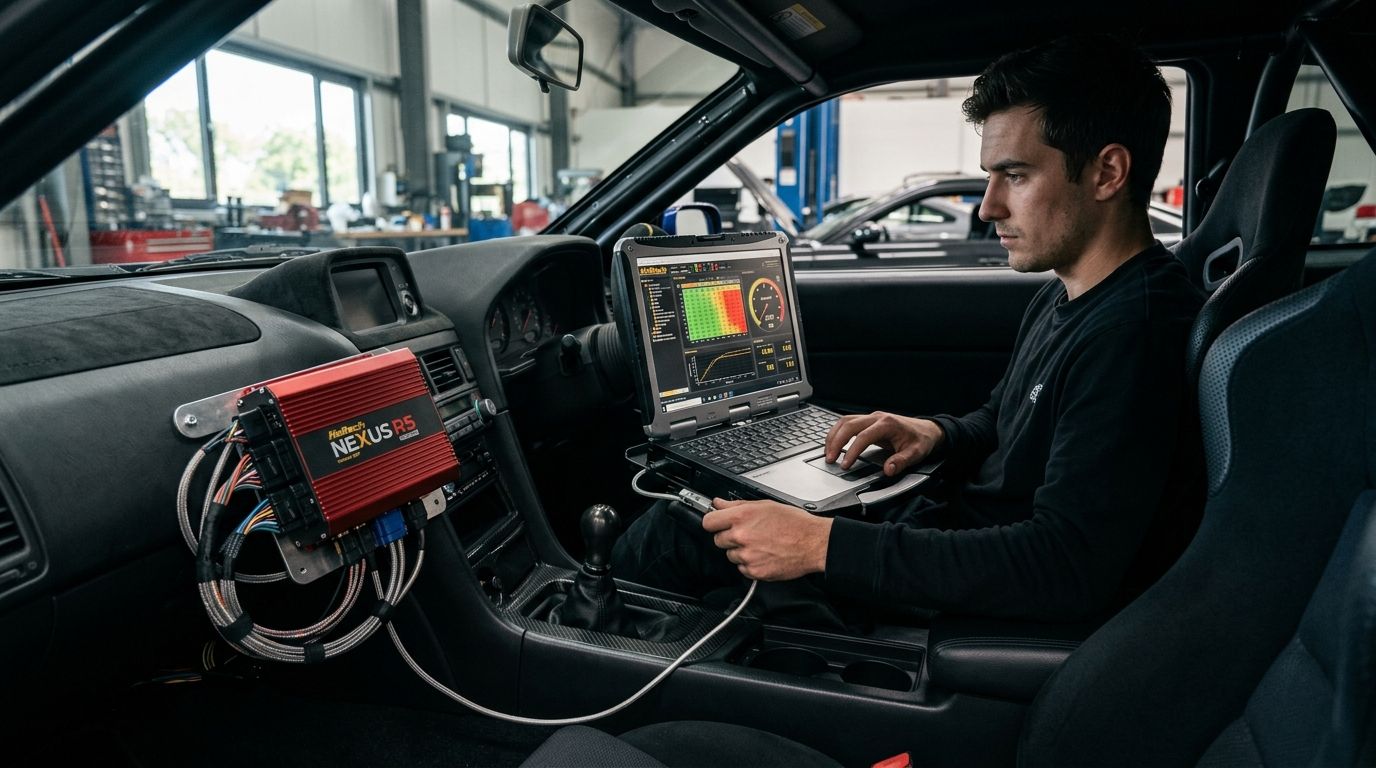
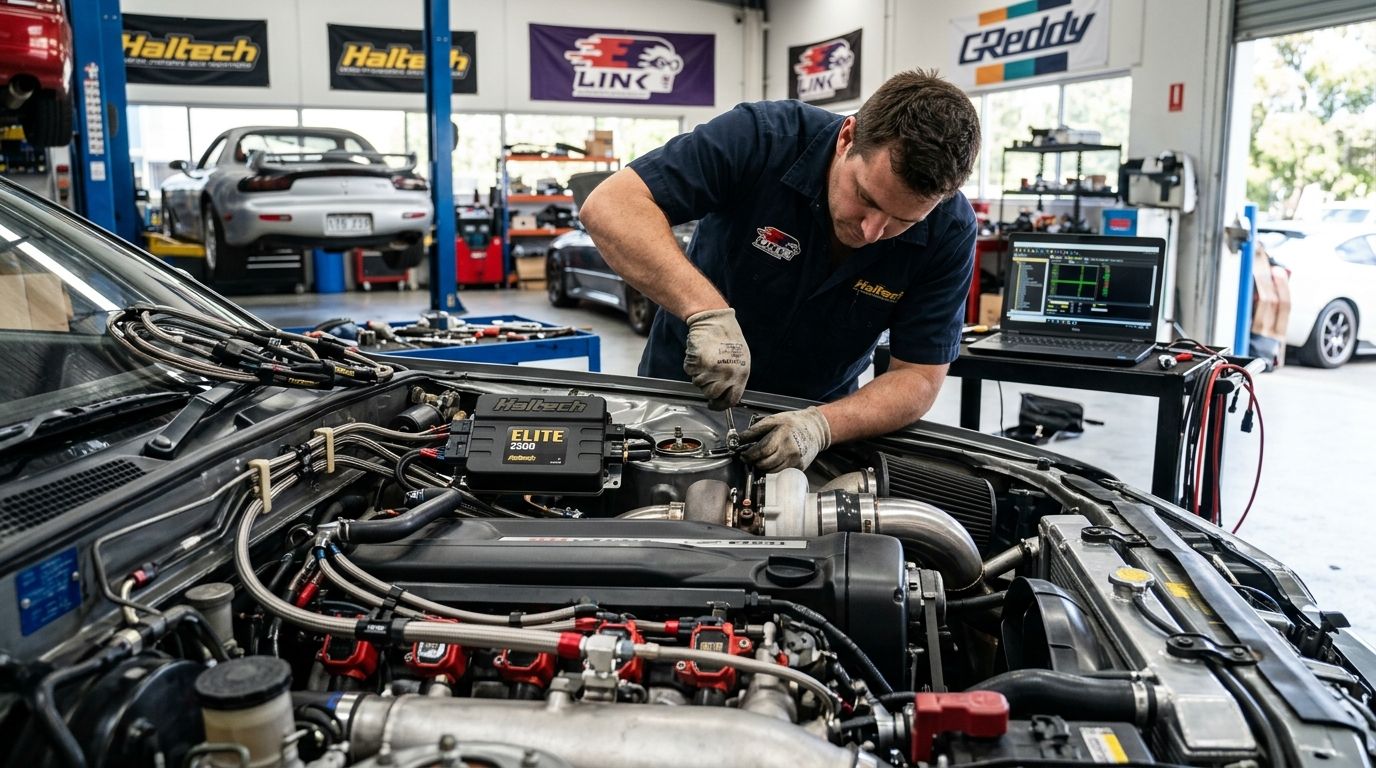
- Tune quality and knock control — a tune that lets detonation slip through spikes cylinder pressure well beyond what boost gauge alone suggests, and reliable ignition matters as much as fuel and timing here; builders chasing consistent combustion under boost put real thought into spark plugs for boosted engines rather than running whatever's cheapest
- Fuel type — E85 unlocks more power at the same boost pressure, which pushes rod bolts into a higher stress bracket sooner than pump fuel
- RPM ceiling — rod stress rises with the square of engine speed, so a rod surviving 18 psi to 6,500rpm can fail well before that boost level at 8,000rpm
- Bearing clearance and oil supply — starved or excessive clearance accelerates big-end wear long before the rod itself is the limiting factor
- Duration of load — a single dyno pull is a different test than repeated full-boost passes down a drag strip or hours of sustained track load
What boost level requires forged aftermarket conrods?
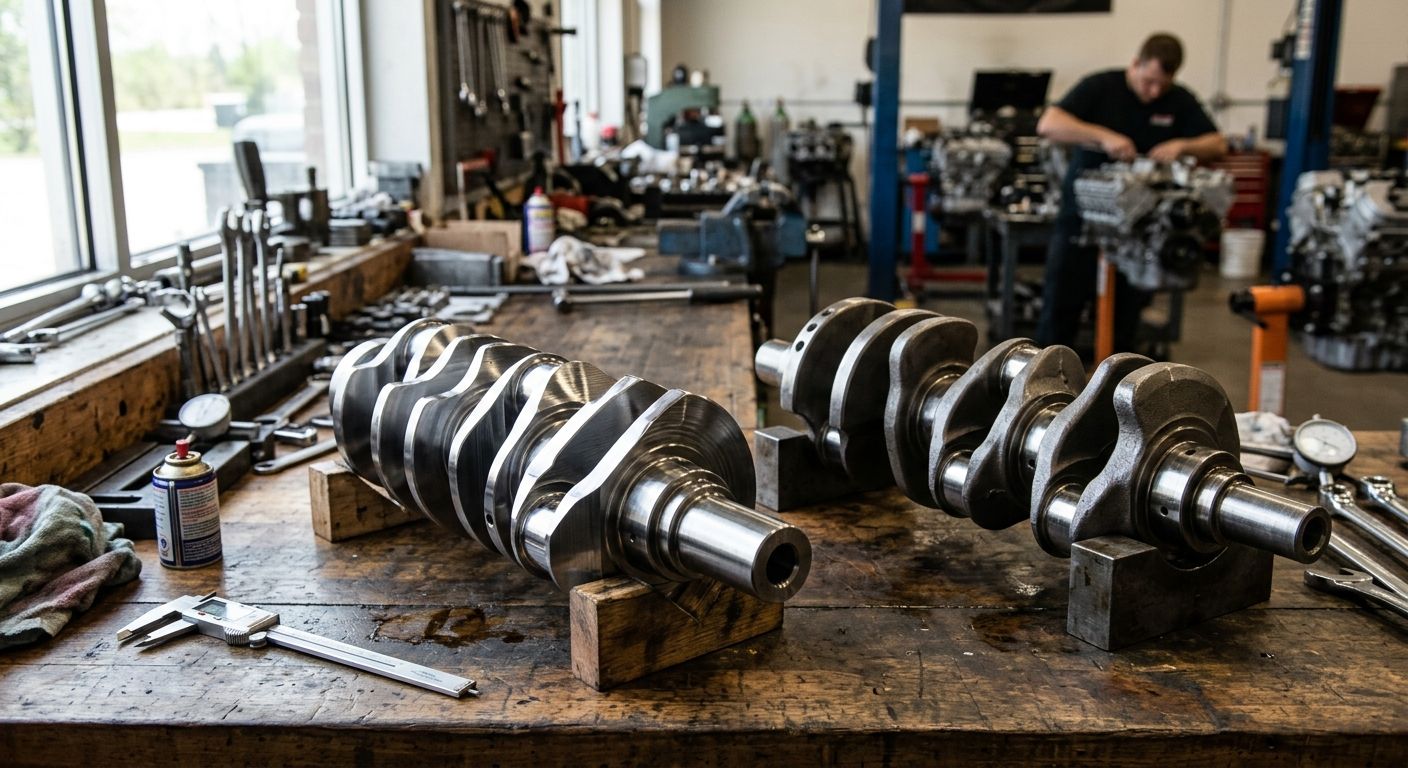
Most engine builders move to forged aftermarket conrods once a build targets sustained boost above roughly 20-25 psi or a power level beyond what the factory rod-and-bolt combination was ever designed to handle, regardless of whether the stock rod started life as cast, powder metal or forged. At that point the question stops being about squeezing more out of the factory part and becomes about fitting a rod rated for the actual cylinder pressure the engine will see.
Can you run E85 on stock conrods?
E85 doesn't change the mechanical load on a conrod by itself, but the extra power it unlocks at the same boost pressure generally pushes an engine into a bracket where the factory rod bolts become the limiting factor sooner than on pump fuel. If a build is moving to E85 alongside a boost increase, treat the fuel switch as a power increase for rod-selection purposes, not a free upgrade.
Do stock rod bolts need to be upgraded before adding boost?
Yes, in most cases — the majority of catastrophic stock-rod failures under increased boost start with the bolt stretching or snapping, not the rod beam bending. A connecting rod bolt upgrade is frequently cheaper insurance than a full rod swap and buys real margin on mild-to-moderate boost increases, though it doesn't turn a cast rod into a forged one.
Where stock rods run out of margin
Once a build is planning sustained boost past the factory rod's realistic ceiling, or moving to E85 and a bigger power target, the factory rod stops being the right part for the job regardless of how careful the tune is. Spool Imports designs and manufactures SPOOL H-Beam and X300 300M I-Beam connecting rods for exactly this transition, and is Australia's largest CP-Carrillo dealer for builds that need a proven billet rod rated well beyond factory limits.
The right choice comes down to the platform, target power and whether the engine is a street car or a dedicated track build — the RB30 engine build guide and the 1000hp Barra combination guide walk through how rod selection changes as the power target climbs on two of the more common six-cylinder platforms Spool Imports sees in 2026.
Need help speccing conrods for a boost increase?
Talk through rod material, bolts and power target before you order.
FAQ
How much boost can stock conrods handle in 2026?
Stock conrods generally hold 8 to 20 psi depending on whether they're cast, powder metal or forged, with cast rods failing earliest and forged factory rods going furthest. Tune quality and rod bolt condition move that ceiling more than the boost number alone.
What's the difference between cast, powder metal and forged factory conrods?
Cast rods have the least tensile strength and the lowest tolerance for detonation, powder metal rods sit in the middle, and forged factory rods are the strongest of the three but still a finite part. Construction, not the engine badge, sets the realistic boost ceiling.
Do I need forged aftermarket rods for 400whp?
It depends on the platform and rod material fitted from the factory — some forged factory rods hold up near that mark, while cast and powder metal rods on the same power target are running with little margin. Check the specific platform's known weak points before assuming the stock rod will cope.
Can a stronger tune let stock rod bolts handle more boost?
A cleaner tune with good knock control reduces the detonation spikes that overload rod bolts, but it doesn't change the bolt's rated clamping strength. Tuning buys margin; it doesn't raise the bolt's actual limit.
Is E85 harder on stock conrods than pump fuel?
E85 itself isn't harder on the rod, but the extra power it unlocks at the same boost pressure pushes rod bolts into a higher stress bracket sooner than pump fuel at the same boost. Treat an E85 switch alongside a boost increase as a power upgrade for rod-selection purposes.
What fails first on a stock rod under too much boost?
The rod bolt fails first in most stock-rod boost failures, stretching or snapping before the rod beam itself bends. That's why a bolt upgrade is often the first practical step before a full rod swap.
Are Barra factory conrods strong enough for a turbo boost increase?
Ford's Barra six-cylinder uses a forged factory rod that has a longer track record holding elevated boost in largely stock form than cast or powder metal factory rods, but it's still a finite component under sustained high RPM. Check current platform-specific guidance before assuming any single boost figure.
When should a build move to SPOOL or CP-Carrillo conrods?
Once a build targets sustained boost or power beyond the factory rod-and-bolt combination's realistic ceiling, a rated aftermarket rod replaces the guesswork. Spool Imports stocks SPOOL H-Beam and X300 300M I-Beam rods alongside CP-Carrillo as the step up from factory rods in 2026.
One last thing
Most stock-rod failure stories blame the rod beam, but the bolt is almost always the actual cause — a rod that snaps a bolt looks identical to one that bent from raw cylinder pressure once the damage is done. Before spending on a full forged rod set, check whether the current rod bolts have ever been replaced or re-torqued; a $150 bolt upgrade sometimes buys the same real-world margin as a boost drop of several psi.