Engine rebuild cost in 2026 isn't a single number you can look up, because it's set by exactly what gets replaced and what tier of parts goes back in. A stock-spec bottom-end refresh sits at one end of the range; a forged stroker build running a billet crankshaft and a standalone ECU sits at the other. The line item that catches most owners out isn't even the parts list — it's machine work, because boring, honing, decking and balancing add hours regardless of which brand of pistons you choose.
- Engine rebuild cost in 2026 is set by scope and parts tier, not a fixed national figure.
- Machine work — boring, honing, decking, balancing — is the hidden cost most builders underquote.
- Cast pistons and stock conrods keep a rebuild basic; forged pistons and H-beam or I-beam conrods raise the safe power ceiling.
- A billet crankshaft only earns its keep once the build targets real power or sustained high RPM, not a stock-power refresh.
- Spool Imports supplies the forged internals, bearings, fasteners and crankshaft options that decide which tier a rebuild lands in.
Why this matters
Rebuilding an engine to the wrong tier is how expensive failures happen. Fitting cast pistons and stock conrods into a build that later gets pushed hard on boost is a common way to turn a cheap rebuild into two rebuilds.
The reverse is just as wasteful: paying for a billet crankshaft and race-spec conrods on an engine that will only ever see stock power is money spent on a ceiling nobody plans to reach. Spool Imports stocks the internal components — pistons, conrods, crankshafts, bearings and fasteners — that decide which of those two mistakes a rebuild makes, and matching parts tier to the actual power target is the single biggest lever on total engine rebuild cost in 2026.
How much does an engine rebuild cost in 2026?
There's no fixed number because a rebuild isn't one job — it's a scope decision. The table below breaks down the three common tiers by what actually changes, not by a dollar figure that varies by workshop, region and engine platform.
| Rebuild tier | What's replaced | Typical parts tier | Machine work required | Best for |
|---|---|---|---|---|
| Stock refresh | Rings, bearings, gaskets, seals | OEM-spec or cast pistons, stock conrods | Light hone, bearing clearance check | Daily driver returned to factory spec |
| Performance rebuild | Pistons, conrods, bearings, gaskets, fasteners | Forged pistons, H-beam conrods, upgraded fasteners | Bore, hone, deck, balance | Turbo or street builds targeting more than stock power |
| Full stroker or race build | Complete rotating assembly | Forged pistons, H-beam or I-beam conrods, billet crankshaft, upgraded bearings | Bore, stroke clearance, align hone, balance, blueprinting | Race engines and high-output street combinations |
A stock refresh is a hold-the-line job — it gets a tired engine back to as-new tolerances and nothing more. A performance rebuild is the right call the moment boost, timing or RPM goes past factory limits. A full stroker or race build is overkill for anything staying under stock power, and underbuilt if it's going into a car chasing four-digit numbers.
Why engine rebuild cost varies
- Engine platform — a V8 with eight bores and a flat-plane or cross-plane crank takes different machine time than an inline six like the Barra or RB30, or a rotary.
- Parts tier chosen — cast pistons and stock conrods versus forged pistons and H-beam or I-beam conrods changes both the parts bill and the safe power ceiling.
- Crankshaft decision — reconditioning the factory crank is a different job entirely to fitting a billet crankshaft rated for higher RPM and cylinder pressure.
- Machine shop scope — bore oversize, align honing, decking and balancing are billed by the hour, and a stroker build needs more of every one of them.
- Ancillary systems replaced — fuel system, ignition, wiring harness and ECU tuning add cost fast when they're bundled into the same job as the internals.
- Target power and RPM ceiling — a rebuild aimed at reliable stock-equivalent power costs less than one built to hold sustained boost or high-RPM race use.
Parts tier decides most of the cost curve
Cast pistons are the cheapest option and hold up fine in a stock-power rebuild, but they crack under detonation and high cylinder pressure — they're not a fit for anything running real boost. Forged pistons cost more up front and buy margin against detonation, higher compression and repeated heat cycles, which is why they're the default choice once a build leaves stock power behind.
Conrods follow the same logic. Stock rods are matched to stock power and stock RPM — push past either and the rod becomes the weak point in the engine. H-beam conrods spread load across a wider cross-section and suit high-horsepower, moderate-RPM combinations; I-beam designs in materials like 300M are built for maximum compressive strength at extreme cylinder pressure and RPM, which is why race teams lean on them for the hardest-running combinations. The forged pistons and conrods breakdown covers how those two rod styles compare in more depth.
Crankshaft choice works the same way. A factory crank, reconditioned correctly, is fine for a stock-power or mild performance rebuild. Once the build is chasing sustained high RPM or serious cylinder pressure, a billet crankshaft becomes the component that keeps the bottom end together — the guide on choosing a billet crankshaft walks through when that upgrade is justified and when it isn't.
Machine work and labour: the invisible half of the bill
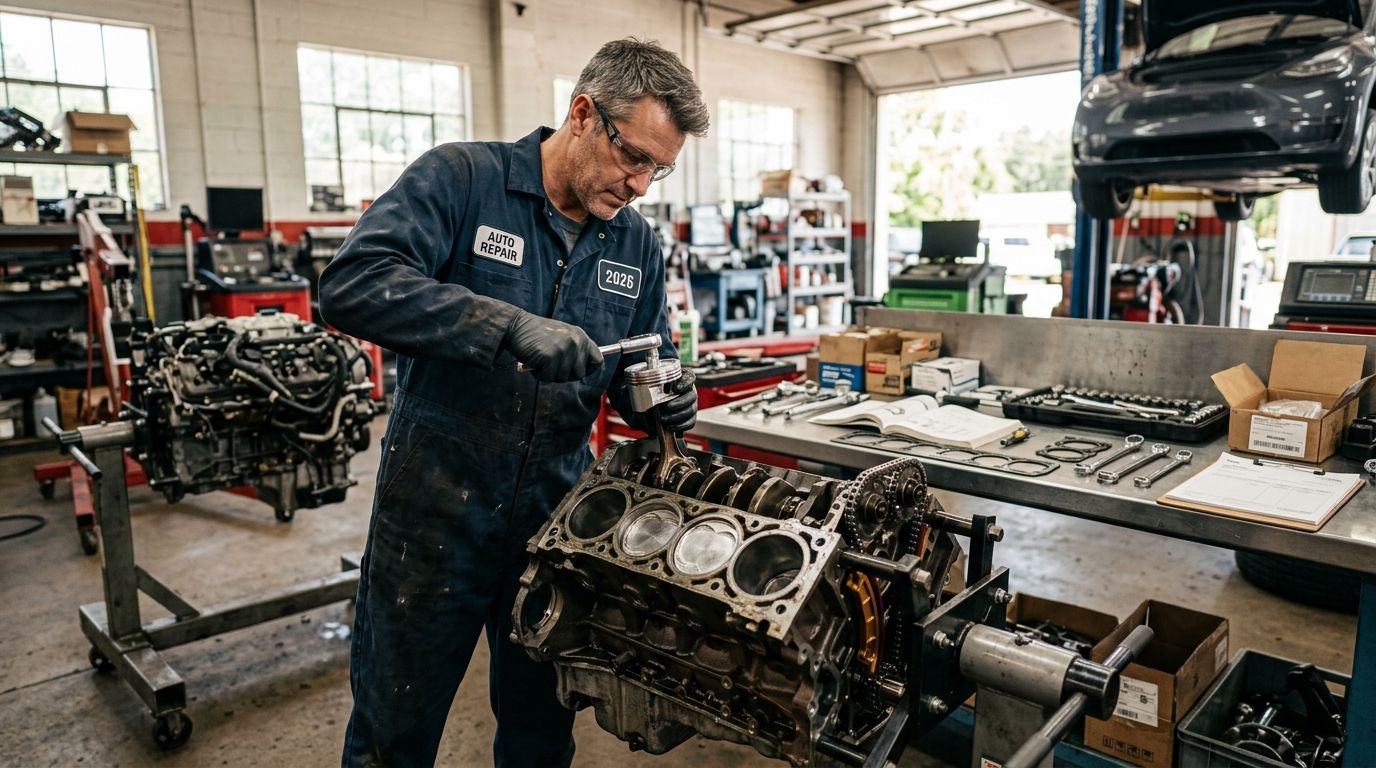
Parts get quoted; machine work often doesn't, and it's the reason two rebuilds with an identical parts list can land at very different totals. Boring and honing the block to accept new pistons, decking the block for a flat, sealed surface, align honing the main tunnel, and balancing the rotating assembly are all billed separately from parts, and every one of them scales with how far the build is pushed from stock.
A stock refresh might only need a light hone and a bearing clearance check. A stroker build needs the block bored and stroke-clearanced, the rotating assembly balanced, and the whole bottom end blueprinted before it goes back together — that's hours of labour on top of the parts bill, and it's the part of engine rebuild cost in 2026 that's hardest to shortcut without risking the result.
Is it cheaper to rebuild an engine or buy a new one?
Rebuilding is generally the cheaper path because it reuses the existing block, head and most ancillaries instead of sourcing a complete replacement engine. The trade-off is time and machine shop backlog rather than dollars — a rebuild depends on parts lead time and workshop scheduling, not a fixed calendar figure.
What's the difference between an engine rebuild and a stroker build?
A standard rebuild returns an engine to its original displacement and spec using OEM-equivalent or forged parts. A stroker build increases displacement by fitting a longer-stroke crankshaft and matched rods and pistons, which is a bigger machining job and a different parts tier entirely — see the stroker kit displacement gains by platform reference for how that plays out across common engines.
Does upgrading pistons and conrods during a rebuild add much to the job?
Swapping cast pistons and stock conrods for forged pistons and H-beam or I-beam conrods during a rebuild adds parts cost, but it's done while the engine is already apart — retrofitting the same upgrade later means paying for the labour twice.
Get the parts tier right the first time
Talk through your rebuild scope and power target with Spool Imports.
FAQ
How much does an engine rebuild cost in 2026?
There's no fixed engine rebuild cost in 2026 because jobs range from a basic stock-spec refresh to a full forged stroker build with a billet crankshaft. Scope and parts tier decide the total, not a national average.
What's included in a standard engine rebuild?
A standard rebuild replaces rings, bearings, gaskets and seals, with the block bored or honed to accept new pistons. It returns the engine to original displacement and factory-equivalent tolerances.
Do I need forged pistons for a rebuild?
Forged pistons are only necessary once the build runs more boost, higher compression or repeated heat cycles than stock. A stock-power daily rebuild runs fine on OEM-spec or cast pistons.
When does a billet crankshaft make sense in a rebuild?
A billet crankshaft earns its place once the build targets sustained high RPM or serious cylinder pressure, not a stock-power refresh. Below that, a correctly reconditioned factory crank is the right call.
Is machine work included in engine rebuild cost?
Boring, honing, decking, align honing and balancing are usually billed separately from parts and scale with how far the build moves from stock. They're the part of the job most often left out of a quick estimate.
Is it worth rebuilding an engine or replacing it outright?
Rebuilding is generally cheaper because it reuses the existing block and most ancillaries instead of sourcing a full replacement engine. The trade-off is turnaround time, which depends on parts lead time and machine shop backlog.
What's the difference between H-beam and I-beam conrods?
H-beam conrods spread load across a wider cross-section and suit high-horsepower, moderate-RPM builds. I-beam conrods in materials like 300M are built for maximum compressive strength at extreme cylinder pressure and RPM.
Does a stroker build cost more than a standard rebuild?
A stroker build costs more than a standard rebuild because it needs a longer-stroke crankshaft, matched rods and pistons, and additional machining for stroke clearance. It's a displacement increase, not a like-for-like refresh.
One last thing
The component that gets skipped most often in a rebuild quote isn't the piston or the rod — it's the conrod bolt. A forged rod with a stock or mismatched bolt is still only as strong as that bolt, and it's a small line item next to pistons or a crankshaft, which is exactly why it gets underestimated in 2026 rebuild planning.