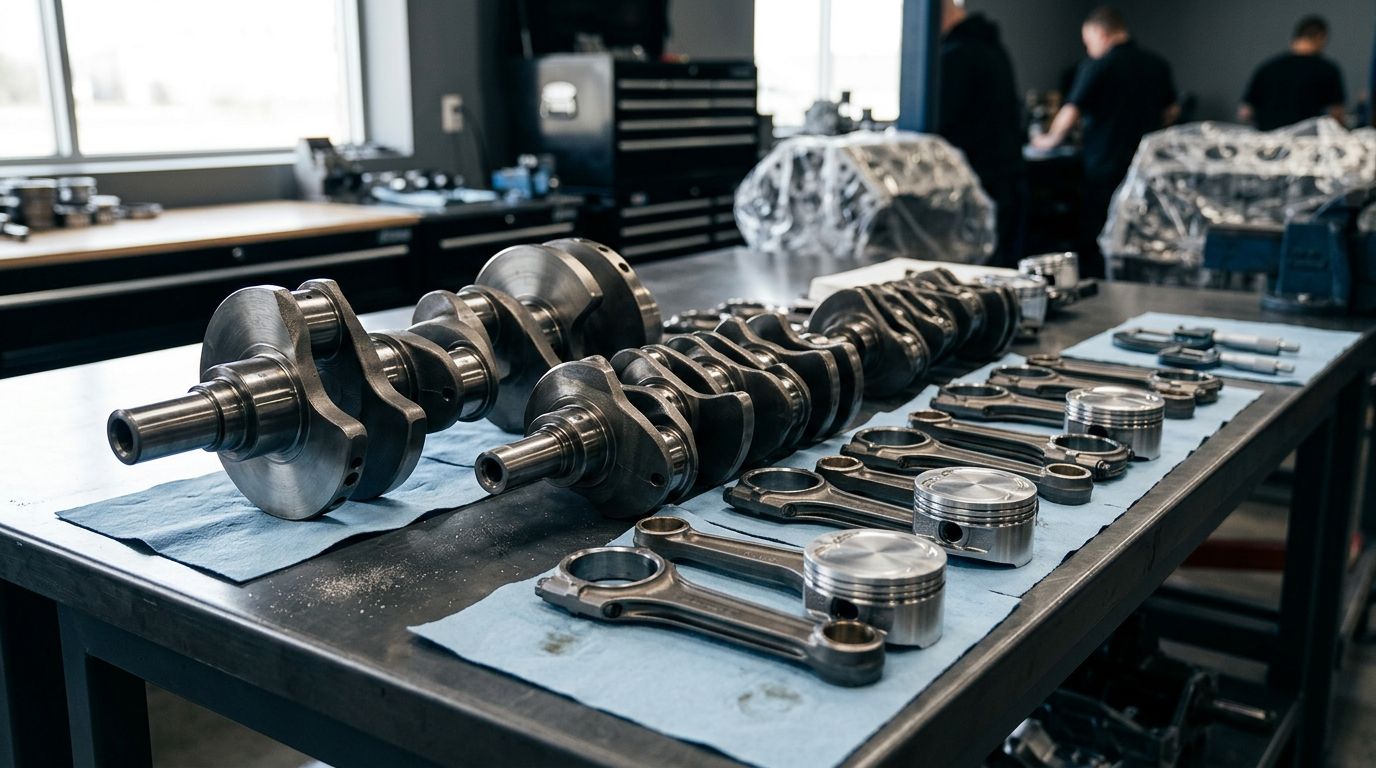
A stroker kit's displacement gain comes down to two numbers: how far the aftermarket crankshaft's stroke exceeds the factory stroke, and how much the block's bore can grow before you run into cylinder wall or head gasket problems. Across the platforms Spool Imports builds for most, the largest common stroker kit adds between 11% and 15% swept volume over stock, with RB30, LS3, 2JZ-GTE and EJ25 all landing in a tight band once you account for real bore-and-stroke figures.
- RB30 gives the biggest stroker kit capacity comparison result: 2.96L to 3.4L is a 15% displacement gain.
- LS3 376ci stroker kits reach 408ci (+8%) or 427ci (+14%) depending on bore and stroke choice.
- 2JZ-GTE stroker builds commonly push 3.0L to 3.4L for a 13% gain using a longer-stroke crank.
- EJ25 stroker kits trail the field at +11% (2.5L to 2.7L) because Subaru's flat-four has less bore room to work with.
- Average largest-kit gain across these four platforms sits at 13% - use that as your baseline before quoting a build.
Why this matters
Customers ask for "the biggest stroker kit available" more often than they ask what the extra capacity actually buys them. On a straight six like RB30, a 15% capacity jump changes torque delivery low in the rev range and shifts where the engine makes peak power. On a flat-four like EJ25, an 11% gain still matters for response, but it won't transform the powerband the way a 400+ci LS stroker does. Knowing the real percentage gain per platform stops both over-promising and under-speccing a build.
Stroker kit capacity comparison by platform
| Platform | Stock displacement | Common stroker kit sizes | Largest kit gain |
|---|---|---|---|
| RB30 I6 (Nissan Skyline/Patrol) | 2.96L (2,962cc) | 3.2L / 3.4L | +15% (3.4L) |
| LS3 V8 (VE/VF Commodore) | 6.2L (6,162cc) | 6.7L (408ci) / 7.0L (427ci) | +14% (7.0L) |
| 2JZ-GTE I6 (Toyota Supra/Chaser) | 3.0L (2,997cc) | 3.4L | +13% |
| EJ25 flat-four (Subaru WRX/STI) | 2.5L (2,457cc) | 2.6L / 2.7L | +11% (2.7L) |
| Average (largest kit, all four platforms) | - | - | +13% |
RB30 leads this comparison at +15%, taking a factory 2.96L six all the way to 3.4L on a billet crank with a longer stroke and matched pistons. EJ25 trails at +11%, going from 2.5L to 2.7L, because Subaru's flat-four block leaves less room to grow bore before deck and water jacket clearances become a problem. LS3 and 2JZ-GTE sit in between at +14% and +13% respectively, both using well-proven 4.000-inch-class bore and longer-stroke crank combinations.
These figures are calculated directly from published bore and stroke specifications for each platform's stock configuration against the largest commonly catalogued stroker kit size, as of 2026. The one thing this table can't tell you: whether your specific block casting, sleeving requirement, or rod length allows you to actually run the largest kit listed - that's a block-by-block check, not a spec-sheet answer.
RB30 - the biggest capacity jump on this list
The RB30 straight six already runs a longer stroke than its RB25 and RB26 relatives, which is exactly why it's the preferred base for further stroking. Kits are sold as 3.2L and 3.4L combinations, built around a longer-stroke crank and pistons matched to compression and rod length. The RB30 stroker kit range covers both sizes, and the broader RB30 engine build guide sets out how the stroker crank interacts with rod ratio and valve spring load at higher RPM.
Best for: builders chasing the largest single-platform capacity gain in this comparison, on a block that already has the deck height to suit it. Watch for: sump and windage clearance at 3.4L - confirm pan and rod-to-block clearance before committing.
LS3 - the widest range of stroker sizes
LS3-based Gen III/IV V8s in VE and VF Commodores stroke from 6.2L (376ci) up to 408ci or 427ci, using the same 4.000-inch bore family with progressively longer strokes and, on the 427, a slightly larger bore too. The LS3 stroker kit guide breaks down which combination suits a street-driven VE against a dedicated drag combination.
Best for: builders who want a choice of two proven kit sizes rather than one fixed stroker spec. Watch for: the 427 combination needs more careful piston-to-valve clearance checking than the 408 due to the larger bore.
2JZ-GTE - a single well-proven stroker size
The 2JZ-GTE's factory 3.0L displacement already gives it more bore-and-stroke headroom than the smaller 1JZ-GTE it's often compared against. Stroker builds on this platform commonly settle on 3.4L using a longer-stroke billet crank rather than offering the multiple sizes LS3 does. Builders working on the smaller Toyota inline six should check the 1JZ-GTE rebuild kit guide first, since the two platforms are often confused when sourcing stroker components.
Best for: builders who want one proven stroker size rather than a menu of options. Watch for: confirm block casting revision before ordering, since not every 2JZ block accepts the same stroker crank without additional clearancing.
EJ25 - the smallest gain, still worth doing
EJ25's flat-four layout means less displacement headroom than any inline six or V8 on this list, but a 2.6L or 2.7L stroker kit still delivers a real 6-11% gain over stock 2.5L. The percentage gain looks modest next to RB30 or LS3, but on a boxer engine that's already tight for bore clearance, it represents the practical ceiling rather than a conservative choice.
Best for: WRX and STI builders who want a genuine capacity increase without moving to a different block family. Watch for: stroker cranks on this platform demand tighter piston-to-wall clearance checks than on the bigger-bore platforms above.
How to use these benchmarks
- Match the stroker size to the goal, not the biggest number available. A 3.2L RB30 kit (+8%) suits a street-driven six just as well as a 3.4L (+15%) suits a dedicated drag combination.
- Check rod length and deck height before locking in a bore-and-stroke combination. A longer stroke changes piston pin height and rod angularity, which is where a lot of stroker builds go wrong.
- Use the average gain (+13%) as a sanity check on quotes. If a stroker kit is being pitched well above that figure for a given platform, confirm the exact bore and stroke before ordering.
- Pair the crank spec with the right fasteners and bearings. A billet crankshaft built for a stroker application needs bearing clearances and bolt torque specs matched to the new stroke, not carried over from the stock combination.
Confirm your stroker kit fitment
Talk through bore, stroke and block compatibility before you order a kit.
FAQ
What is a stroker kit and how does it increase engine displacement?
A stroker kit pairs a longer-stroke crankshaft with matching pistons and connecting rods, moving the piston further down the bore each stroke and increasing swept volume without changing the block's outer dimensions. The gain is set by how much longer the new stroke is compared to stock, combined with any bore increase the block allows.
How much displacement does a stroker kit typically add?
Across RB30, LS3, 2JZ-GTE and EJ25, the largest common stroker kit adds 11% to 15% over stock displacement, averaging around 13% for the biggest kit available on each platform. Smaller stroker sizes on the same platform add proportionally less.
Is a 3.4L RB30 stroker kit worth it over a 3.2L kit?
A 3.4L RB30 stroker gives a 15% displacement gain over stock compared to 8% for the 3.2L kit, but it demands tighter checks on sump clearance and rod-to-block clearance. It suits builders chasing maximum capacity on a well-prepped block rather than a straightforward street rebuild.
What's the biggest LS3 stroker kit size available?
The largest common LS3 stroker combination in this comparison is 427ci (7.0L), a 14% gain over the stock 6.2L (376ci) short block. The 408ci (6.7L) option is the more common street-focused alternative at an 8% gain.
Do EJ25 stroker kits require sleeving the block?
Whether sleeving is required depends on the specific bore increase chosen and the condition of the factory block, not the stroke length alone. Confirm bore tolerance on the actual block before assuming a 2.6L or 2.7L kit will drop straight in.
How much bigger is a 2JZ 3.4L stroker than stock 2JZ-GTE?
A 3.4L 2JZ-GTE stroker build is a 13% displacement gain over the factory 3.0L configuration, using a longer-stroke billet crank rather than a bore increase alone.
Does a bigger stroker kit always mean more power?
No - displacement gain sets the ceiling on torque potential, but actual power depends on the supporting valvetrain, fuel system and tune. A 15% capacity gain on RB30 still needs matched valve springs and fuelling to show up as usable power.
What limits how much stroke a block can take?
Deck height, rod length, and piston pin height set the practical limit on stroke before the piston contacts the head or the rod runs into the crankcase. This is why every platform on this list tops out at a specific, well-proven stroker size rather than an unlimited range.
One last thing
The biggest number on this table (RB30's +15%) isn't automatically the right choice - it's also the combination that most often gets let down by an unchanged sump, oil pump or valve springs carried over from the stock engine. Before locking in any stroker kit in 2026, check the supporting valvetrain against the new rev range: a valve spring upgrade for a high-revving RB stroker build is the component most often missed when a capacity gain gets specced without checking what the rest of the engine needs to keep up.