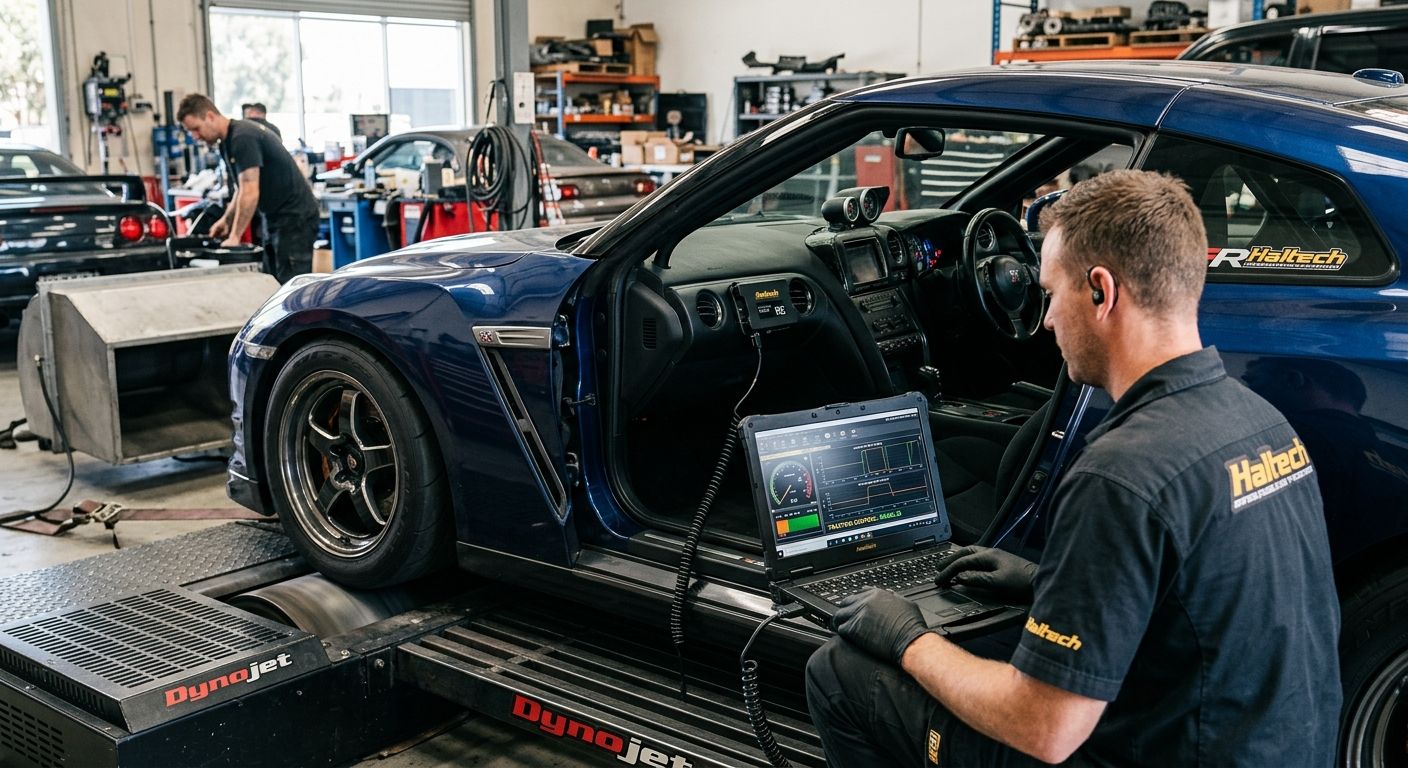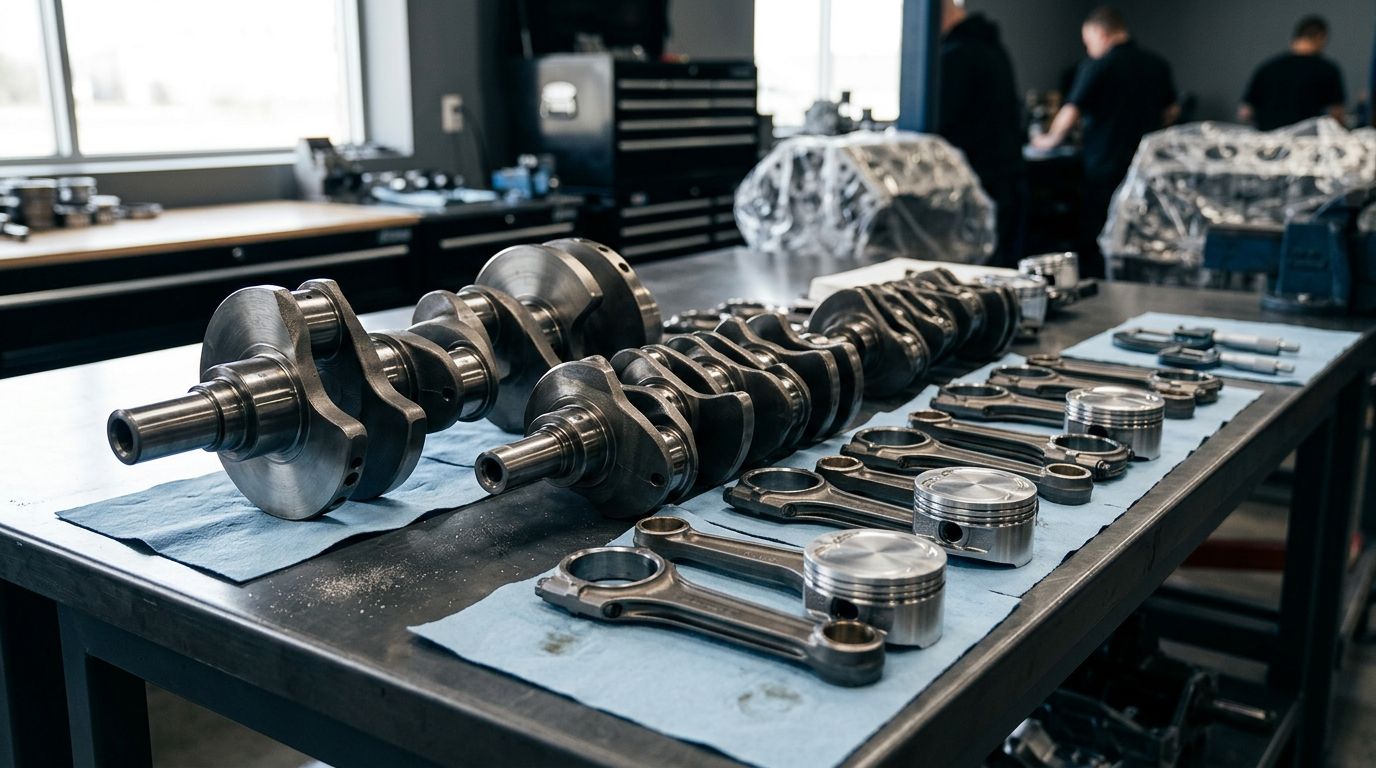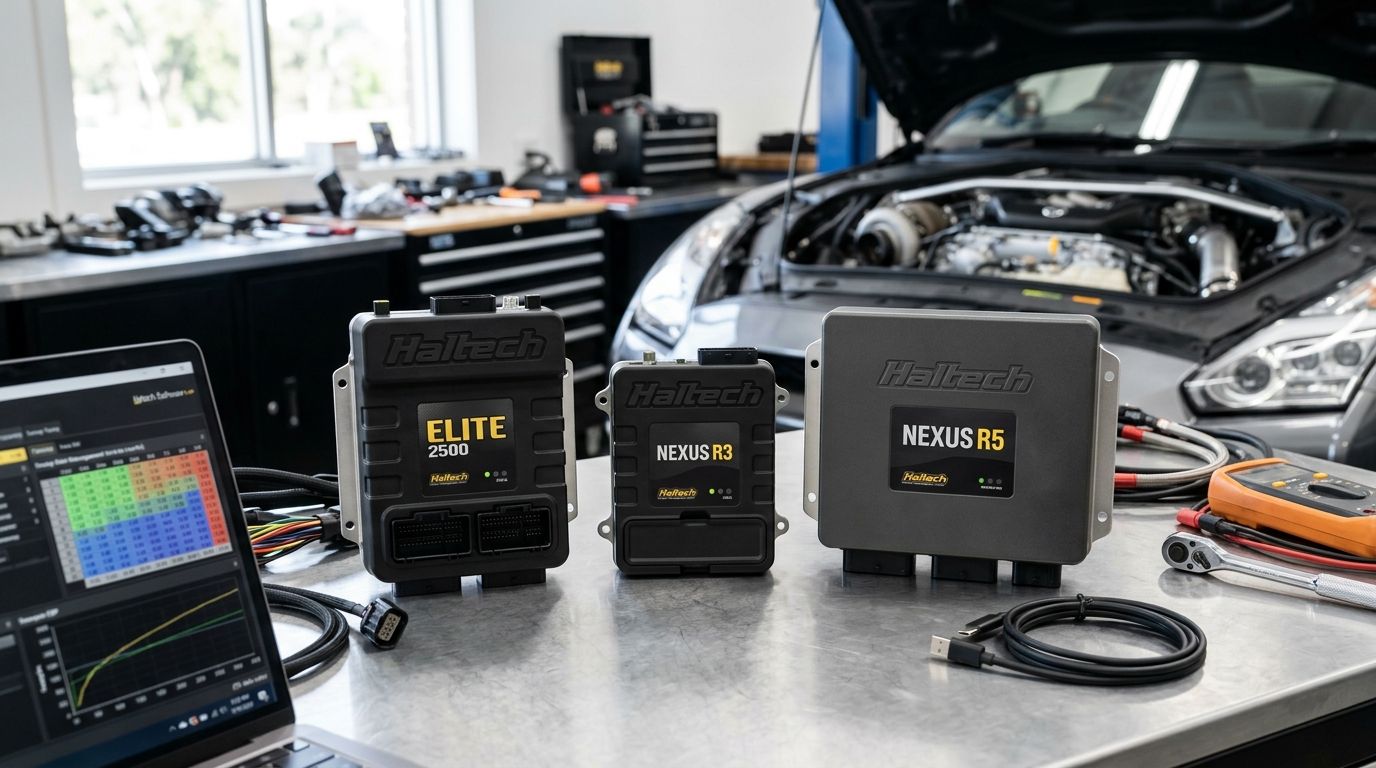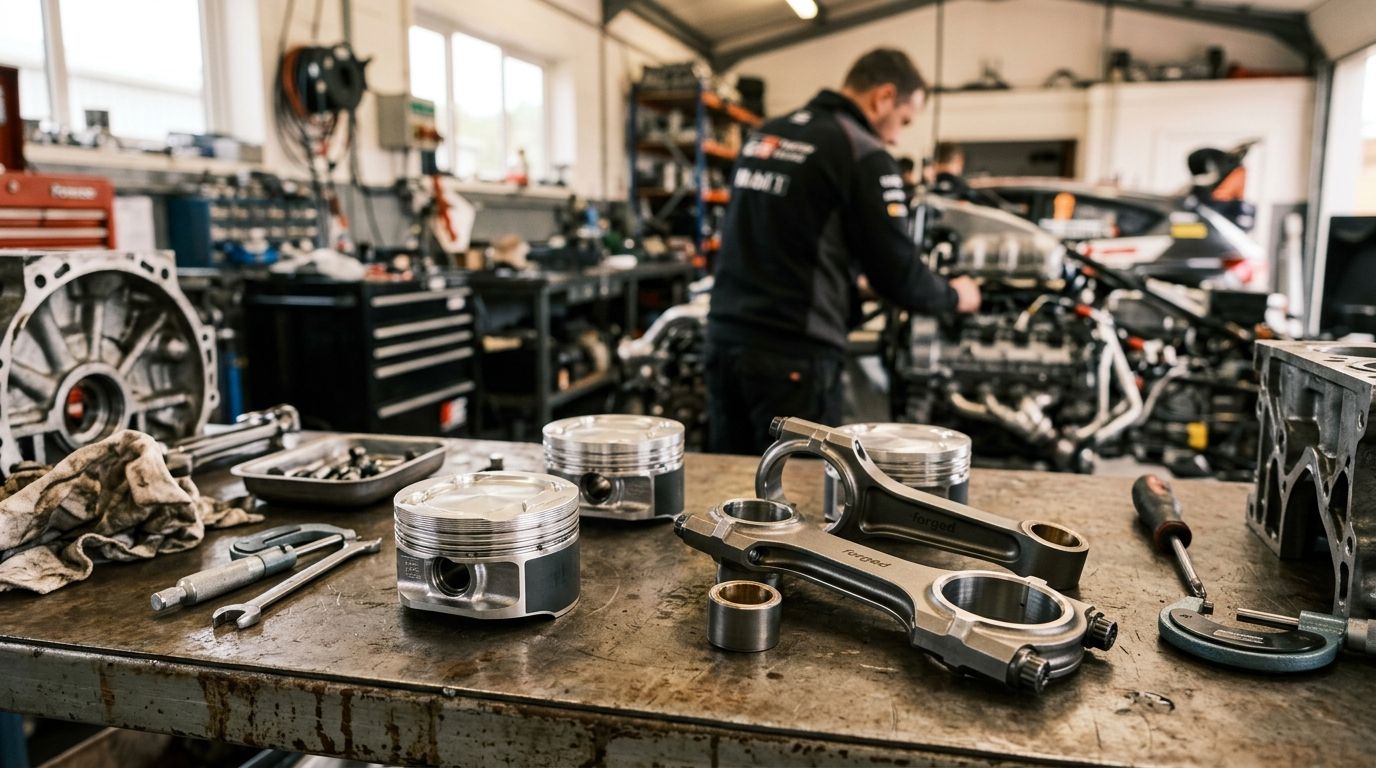
Forged pistons and conrods for race teams are the rotating assembly components built to survive repeated high-load cycles, detonation risk and rev ceilings that a street engine never sees across its service life. A race engine gets torn down, measured and rebuilt on a schedule dictated by race weekends, not by odometer mileage, so tolerances that would pass on a daily driver become the difference between finishing a session and a bent rod on the front straight.
- Forged pistons and conrods for race teams need alloy and beam design matched to boost, fuel and rev ceiling, not picked from a generic parts list.
- 2618 alloy pistons suit boosted and nitrous combinations; 4032 suits stable, naturally aspirated loads.
- H-beam conrods handle high cylinder pressure from boost; I-beam suits lighter, high-rpm naturally aspirated builds.
- Bearing clearance and rod bolt stretch drift across a race season and need measuring at every teardown, not assumed from the last build.
- Spool Imports distributes CP-Carrillo conrods and stocks SPOOL branded H-Beam and X300 300M I-Beam conrods for race-specific combinations.
Why this matters for race teams
A race team runs an engine to the edge of its material limits every session, then tears it down and inspects it before the next one. That inspection cycle is the point of the exercise: a street build gets checked once a year, a race build gets checked between rounds, and any clearance or stretch reading that has drifted out of range gets caught before it turns into a failure on track.
That's a different design brief to a weekend street car. Forged pistons and conrods for race teams have to tolerate that inspection cadence and the load spikes of full-throttle, high-rpm running lap after lap, not just survive one dyno pull. Spool Imports distributes forged piston and conrod ranges built around that use case, alongside the technical advice to match components to a specific combination rather than sell parts off a shelf.
Build the rotating assembly around your combination
Match piston and conrod material to your rev ceiling and load cycle
Start with the numbers your data logger actually shows, not the tacho sweep or the factory redline. Cylinder pressure and rev ceiling drive alloy and material choice more than a horsepower figure does.
- Confirm actual shift RPM and sustained rev ceiling from logged data, not a guessed redline
- Choose 2618-T6 alloy pistons for boosted or nitrous combinations with variable cylinder pressure spikes
- Reserve 4032 alloy pistons for naturally aspirated combinations running stable, predictable peak pressure
- Match conrod material — forged 4340 steel or billet — to the load the rod bolts see at your rev ceiling
- Confirm compression ratio against fuel octane and boost target before locking in piston specs
Select conrod beam design for your load path
Beam design isn't a preference call, it's a load-path decision. H-beam and I-beam rods handle compressive and tensile loading differently, and picking the wrong one for your combination shows up as premature big-end wear or bent rods under boost.
- Run H-beam conrods where high cylinder pressure from boost or nitrous dominates the load path
- Run I-beam conrods where reciprocating mass matters more than peak pressure, typically high-rpm naturally aspirated builds
- Check big-end bolt spacing matches your crank journal before ordering, not after
- Verify rod length maintains correct piston pin height without needing an eyebrow relief cut
- Cross-check rod weight against your existing rotating assembly to avoid an unplanned rebalance job
Set piston-to-bore and ring gap for your fuel and boost level
Ring gap and piston-to-bore clearance both move with fuel type and boost level. Getting either wrong bleeds cylinder pressure or lets the piston hammer the bore under load.
- Set ring end gap using roughly 0.0045 inch per inch of bore as a starting point for boosted combinations, tightening for naturally aspirated builds
- Increase piston-to-bore clearance for methanol or E85 combinations running higher cylinder pressure than pump fuel
- Confirm skirt coating and pin retention style (clips versus tool-steel buttons) suit your RPM ceiling
- Check top ring material — gas-nitrided steel or plasma-moly — against your fuel and boost combination
Working through alloy, beam design and fuel-matched clearances from first principles takes real time, and most race teams don't have a spare week between rounds to run that process from scratch. A forged piston brand comparison built around real combinations shortens that decision considerably.
Match rod bolts to your load
Rod bolts are a service item on a race engine, not a set-and-forget fastener. Reusing them past their rated life is one of the more common ways a sound bottom end fails.
- Measure bolt stretch with a stretch gauge at every teardown rather than trusting a torque wrench reading alone
- Replace bolts once stretch readings move outside the manufacturer's specified range, regardless of visible condition
- Match bolt material grade to peak rod loading, not to whatever came bundled with the kit
- Keep a stretch log per bolt set so drift across a season is obvious, not guessed at
Check bearing clearance for extended run times
Bearing clearance that's correct for a fresh build can drift by the end of a race season, and oil pressure at redline is the first place that drift shows up.
- Check running clearance sits in the typical 0.0020 to 0.0028 inch range for high-load applications, adjusted for oil viscosity
- Confirm oil pressure holds steady at sustained redline, not just at idle on the dyno
- Inspect bearing crush and crown at every teardown, not only when a problem is suspected
- Match bearing material to load — tri-metal versus bi-metal — based on peak cylinder pressure
Confirm rotating assembly balance and crank strength
A forged piston and conrod combination is only as strong as the crankshaft it bolts to. A billet crank paired with race-spec rods and pistons is a common upgrade path once a stock or cast crank becomes the weak link in the assembly.
- Confirm crank material (cast, forged, or billet) matches the load your new pistons and rods are rated for
- Rebalance the full rotating assembly whenever piston or rod weight changes from the previous build
- Check journal finish and fillet radius against your target rev ceiling
- Verify oil clearance at every main and rod journal after any crank change
A billet crankshaft selection guide is worth reading alongside a piston and conrod upgrade, since the three components are rated as one system, not three separate purchases.
Build a documentation and spares plan for race weekends
A race engine that fails scrutineering paperwork doesn't get to start, regardless of how good the parts are. Keep records as tight as the tolerances.
- Keep certified spec sheets for every piston, rod and bearing on hand for scrutineering
- Carry a spare ring, bearing and fastener set sized for a same-weekend rebuild
- Log every clearance and stretch measurement at each teardown, not just the ones that look off
- Plan turnaround windows before the next event, not after a failure forces one
Get help specifying your race combination
Talk through piston, conrod and bearing selection before your next build.
Comparing forged piston and conrod options for race teams
| Option | Best for | Key limitation |
|---|---|---|
| 2618 forged piston + H-beam conrod | High-boost or nitrous combinations with variable cylinder pressure | Higher thermal expansion needs larger piston-to-wall clearance, adds piston slap on cold start |
| 4032 forged piston + I-beam conrod | Naturally aspirated race engines with stable, high-rpm load | Lower fatigue tolerance under boost spikes or detonation events |
| Billet piston + 300M I-beam conrod | Extreme cylinder pressure or extended endurance racing | Longer lead time to source and machine than off-the-shelf forged sets |
| CP-Carrillo forged piston and rod set | Teams wanting matched, documented components for scrutineering | Still needs confirming exact bore, stroke and pin specs against your block |
Verdict: match the option to your load path, not to brand reputation — a 4032 piston in a boosted combination fails the same way regardless of who forged it.
Common mistakes race teams make with pistons and conrods
- Reusing rod bolts on stretch guesswork. Assuming bolts are fine because they've only done a handful of sessions, instead of measuring stretch at every teardown.
- Skipping a ring gap re-check after a fuel change. Moving from pump fuel to E85 or methanol without re-setting ring end gap for the new cylinder pressure.
- Letting bearing clearance drift unmeasured across a season. Treating bearings as fit-and-forget instead of a wear item checked at every rebuild.
- Ordering pistons and conrods without confirming crank compatibility. Buying a rod and piston combination before checking journal size and rod length against the existing crankshaft.
- Carrying paperwork that doesn't match the parts actually fitted. Turning up to scrutineering with spec sheets for a superseded piston or rod revision.
FAQ
What's the difference between forged and cast pistons for race engines?
Forged pistons are compressed from aluminium billet under high pressure, giving a finer grain structure and higher fatigue strength than cast pistons. Race engines need that fatigue tolerance because they run repeated high-load cycles that a cast piston isn't built to sustain.
Is 2618 or 4032 alloy better for a turbocharged race engine?
2618 alloy suits turbocharged and nitrous race engines because it holds up better under higher cylinder pressure and thermal shock. It needs more piston-to-wall clearance than 4032, which is better suited to stable, naturally aspirated loads.
Are H-beam or I-beam conrods better for racing?
H-beam conrods handle high cylinder pressure from boost or nitrous better than I-beam rods. I-beam rods are lighter and suit high-rpm naturally aspirated engines where reciprocating mass matters more than peak cylinder pressure.
How often should race teams replace conrod bolts?
Replace rod bolts based on measured stretch, not a calendar or mileage interval. Measure stretch with a gauge at every teardown and replace any bolt reading outside the manufacturer's specified range.
What bearing clearance should a race engine run?
Running clearance for high-load race applications typically sits between 0.0020 and 0.0028 inch, adjusted for oil viscosity and load. Check clearance and bearing crush at every teardown rather than assuming it holds from the last build.
Does Spool Imports stock CP-Carrillo conrods?
Yes, Spool Imports is Australia's largest CP-Carrillo dealer and distributes their forged piston and conrod ranges alongside SPOOL branded H-Beam and X300 300M I-Beam conrods.
What ring gap should a race engine run?
A common starting point is roughly 0.0045 inch of ring end gap per inch of bore for boosted combinations, tightened for naturally aspirated builds. Fuel type and cylinder pressure both shift this figure, so it's a starting point, not a fixed rule.
Can race teams reuse rod bolts across a full season?
Only if stretch measurements at every teardown stay inside the manufacturer's specified range. Reusing bolts based on session count alone, without measuring stretch, is one of the more common causes of bottom-end failure in race engines.
One last thing
Most rotating assembly failures traced back to pistons or conrods don't actually start there — they start at a bearing clearance that drifted unmeasured between race weekends. Piston and conrod selection sets the ceiling for what an engine can handle in 2026; bearing inspection discipline decides whether it actually gets there race after race.