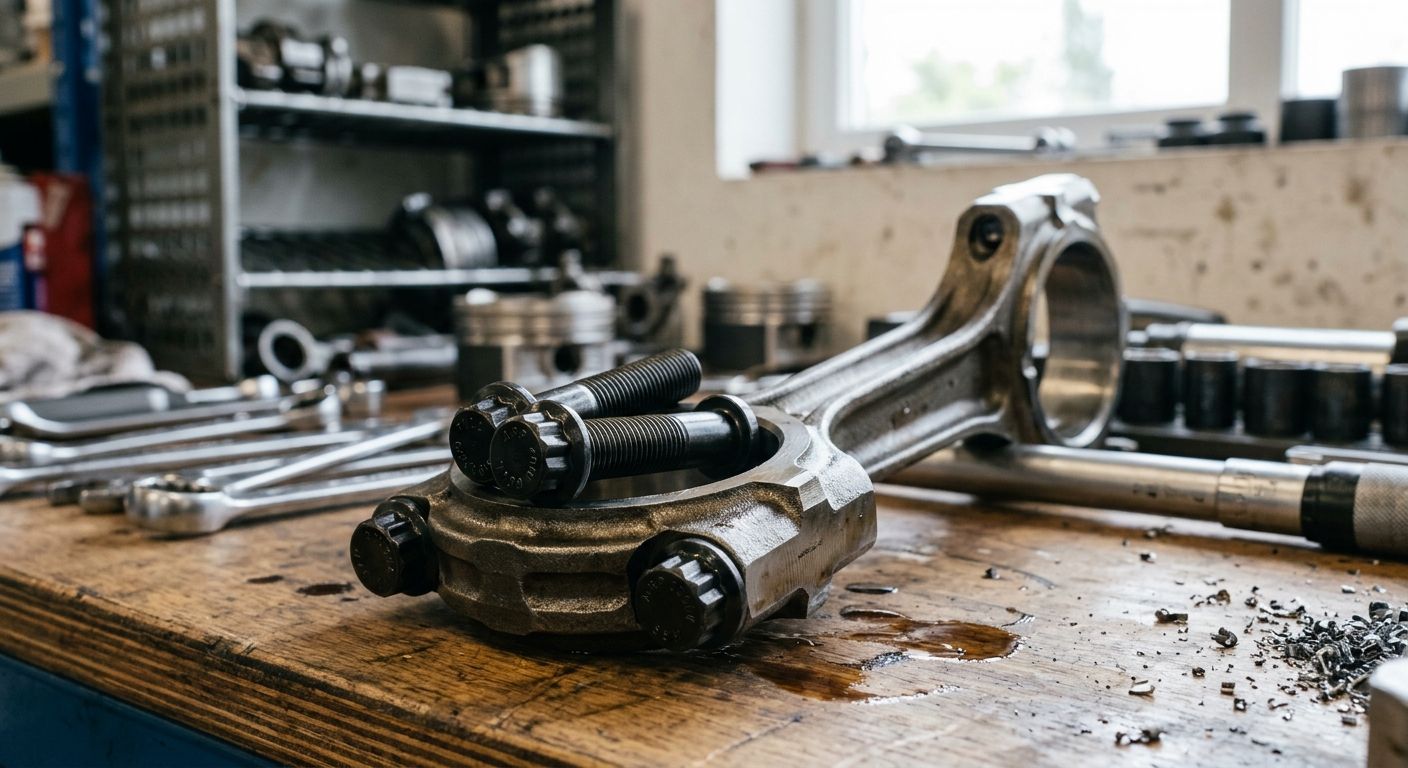
Connecting rod bolts are the single most common failure point in a high horsepower conrod build before the rod itself ever lets go — get the bolt spec wrong and the strongest forged rod on the market is only as good as its weakest fastener.
- ARP Custom Age 625+ rod bolts are the strongest widely-available option for high horsepower and high-cyclic race builds in 2026.
- ARP2000 rod bolts, rated around 200,000 psi tensile, remain the standard upgrade for street and mild forced-induction combinations.
- CP-Carrillo CARR bolts are the matched-system choice when the connecting rod itself is a CP-Carrillo unit.
- Factory rod bolts are not rated for sustained boost or nitrous loads and should be replaced on any engine pushed past stock power.
Why this matters
A connecting rod is only as strong as the two bolts clamping its cap on. Every high-cyclic load event — every combustion cycle, every gear change, every over-rev — puts tensile stress through those bolts thousands of times a minute, and fatigue failure at the bolt is far more common in high horsepower builds than a cracked rod beam.
Spool Imports distributes the full ARP fastener range and stocks CP-Carrillo hardware as Australia's largest CP-Carrillo dealer, so the bolt selection question comes up on nearly every rod-related build enquiry in 2026. Picking the right bolt for the application matters more than picking the most expensive one on the shelf.
What makes the best connecting rod bolt
- Alloy composition — 8740 chromoly, 625+ alloy or a proprietary CP-Carrillo material, each with a different tensile ceiling and fatigue behaviour.
- Tensile strength rating — the raw yield point of the material, published by the manufacturer and directly comparable across brands.
- Fatigue life under cyclic loading — how the bolt handles thousands of repeated stretch-release cycles, not just a single peak load.
- Stretch vs torque-to-yield installation method — bolt stretch measured with a stretch gauge gives a more consistent clamp load than torque alone.
- Thread pitch and diameter compatibility — the bolt has to match the rod's big-end bore and thread spec exactly; there's no universal fit across brands.
- Application match — street, drag, circuit racing, nitrous and diesel duty all load a bolt differently, and no single bolt is correct for all of them.
Connecting rod bolts at a glance
| Bolt option | Best for | Standout feature | Key limitation |
|---|---|---|---|
| ARP2000 | Street and mild forced induction upgrades | 200,000 psi tensile, 8740 chromoly | Not rated for sustained extreme cyclic loads |
| ARP Custom Age 625+ | High horsepower and high-cyclic race builds | 260,000 psi tensile, 625+ alloy | Higher cost per bolt than ARP2000 |
| CP-Carrillo CARR bolts | Engines running CP-Carrillo connecting rods | Matched to CP-Carrillo big-end geometry | Only sold as a system with CP-Carrillo rods |
| ARP L19 | Extreme-duty cyclic fatigue applications | Optimised for fatigue life over raw tensile peak | Overkill for typical street/strip builds |
| Factory/OEM bolts | Unmodified stock-power engines | No added cost, factory fitment | Not designed for boost, nitrous or high rpm |
1. ARP2000 Rod Bolts: best entry-level upgrade for street and mild forced induction builds
ARP2000 is the standard first-step upgrade from factory rod bolts on almost every high-cyclic build in the Spool catalogue. The 8740 chromoly alloy is heat-treated to a tensile strength around 200,000 psi, which covers the majority of street and mild boost combinations without pushing into specialist territory.
ARP2000 pros:
- Proven fatigue life across decades of aftermarket use
- Compatible with most H-Beam and I-Beam conrod designs on the market
- Consistent stretch behaviour when installed with a stretch gauge rather than torque alone
ARP2000 cons:
- Tensile ceiling is lower than 625+ alloy options
- Not the right choice once nitrous or sustained high boost enters the combination
Best for: street and mild forced-induction engines where rod bolts are the first upgrade off factory hardware. Verdict: Buy for daily-driven and mild street/strip combinations.
2. ARP Custom Age 625+ Rod Bolts: best for high horsepower and high-cyclic race builds
ARP Custom Age 625+ steps up to a 260,000 psi tensile rating, built from a proprietary 625+ alloy specifically for engines running sustained boost, nitrous, or repeated high rpm cycling. This is the bolt spec most commonly paired with SPOOL H-Beam and X300 I-Beam conrods on builds targeting serious four-digit power.
ARP Custom Age 625+ pros:
- Highest tensile rating in the standard ARP lineup
- Better fatigue resistance under repeated high-load cycles than ARP2000
- Suits both forced induction and naturally aspirated high-rpm applications
ARP Custom Age 625+ cons:
- Costs more per bolt than ARP2000
- Unnecessary for engines running under moderate boost or stock-adjacent power
A build running forced induction with a matched forged piston brand comparison should be specifying rod bolts to the same tier — there's no point running a top-shelf piston on a bottom-shelf bolt.
Best for: high horsepower forced induction and nitrous builds where rod bolt fatigue life under repeated cycling is the limiting factor. Verdict: Buy for any combination targeting sustained high boost or four-digit power.
3. CP-Carrillo CARR Bolts: best matched-system option for CP-Carrillo connecting rods
CP-Carrillo rods ship with the manufacturer's own CARR bolt as a matched system, engineered around the specific big-end geometry and spiral-lock design CP-Carrillo uses instead of a conventional cap bolt arrangement. As Australia's largest CP-Carrillo dealer, Spool Imports supplies these as a complete rod-and-bolt package rather than as a standalone aftermarket fastener.
CP-Carrillo CARR bolts pros:
- Purpose-matched to CP-Carrillo big-end tolerances
- No mixing of third-party bolt specs against a CP-Carrillo rod
- Consistent with the rod manufacturer's own fatigue and clamp-load engineering
CP-Carrillo CARR bolts cons:
- Not sold separately from CP-Carrillo rod sets
- Not a drop-in option for rods from other manufacturers
Best for: engines already specified around CP-Carrillo connecting rods. Verdict: Buy as the default choice whenever the rod itself is CP-Carrillo.
4. ARP L19 Rod Bolts: best for extreme-duty cyclic fatigue applications
ARP L19 is optimised less for a single peak tensile number and more for fatigue life across an extremely high number of load cycles — the profile that matters most in diesel and extreme-duty applications where the bolt sees millions of stress cycles over its service life.
ARP L19 pros:
- Strong fatigue resistance under sustained cyclic loading
- Suited to applications with very high duty cycles
ARP L19 cons:
- Not necessary for typical street, strip or circuit race builds
- Premium spec that's overkill outside extreme-duty use cases
Best for: diesel and extreme-duty engines with very high cyclic load counts. Verdict: Hold unless the application specifically calls for extreme fatigue duty — most performance builds are better served by ARP2000 or 625+.
5. Factory/OEM Rod Bolts: best for unmodified stock-power engines only
Factory rod bolts are engineered to a cost and durability target set by the original vehicle manufacturer for stock power output, not for boost, nitrous or sustained high rpm. They're not a bad component — they're simply not designed for anything beyond the power level the engine left the factory with.
Factory/OEM bolts pros:
- No added cost on an unmodified engine
- Adequate for the power level the engine was designed around
Factory/OEM bolts cons:
- No published aftermarket tensile rating for direct comparison
- Fatigue life drops sharply once boost, nitrous or high rpm is introduced
Best for: engines staying at or near factory power output. Verdict: Skip once the build plan includes forced induction, nitrous or a rev ceiling above factory spec.
How we ranked these rod bolts
Each option above is ranked against the six criteria listed earlier — alloy composition, tensile rating, fatigue life, installation method, thread compatibility and application match — rather than against brand reputation. A bearing clearance or racing engine bearings spec sheet follows the same logic: match the component to the load the engine actually generates, not to what's popular on forums.
Which connecting rod bolt should you choose?
For most 2026 builds stepping up from factory rods, ARP2000 is the correct default — proven fatigue life at a 200,000 psi tensile rating covers the bulk of street and mild boost combinations. Once the build plan includes sustained high boost, nitrous, or a rev ceiling well past factory limits, ARP Custom Age 625+ is the right move at 260,000 psi tensile. If the rod itself is a CP-Carrillo unit, the CARR bolt that ships with it is the only sensible choice — don't mix third-party bolts against CP-Carrillo big-end tolerances.
Bottom-end component selection doesn't stop at the bolt. A billet crankshaft selection has to be matched to the same power target, and platforms chasing serious numbers — see the 1000hp Barra engine combination guide as one example — treat every fastener in the rotating assembly as part of one matched system, not a shopping list of individually strong parts.
Need help matching rod bolts to your build?
Get fastener spec advice for your target power and combination.
FAQ
What are the best connecting rod bolts for a high horsepower build?
ARP Custom Age 625+ rod bolts, rated around 260,000 psi tensile, are the strongest widely-available option for high horsepower and high-cyclic race builds in 2026. ARP2000 at 200,000 psi tensile covers street and mild forced-induction combinations.
Is ARP2000 or ARP Custom Age 625+ better for a turbo build?
ARP2000 suits street and mild boost combinations, while ARP Custom Age 625+ is the better choice once the build runs sustained high boost or nitrous. The 625+ alloy has a higher tensile ceiling and better fatigue life under repeated high-load cycles.
Can I use ARP rod bolts with CP-Carrillo connecting rods?
No — CP-Carrillo rods use a spiral-lock CARR bolt matched to the rod's specific big-end geometry, and this ships as part of the CP-Carrillo rod set rather than as a separate aftermarket fastener.
Do I need to upgrade rod bolts if I'm upgrading the pistons and conrods?
Yes — rod bolts should be specified to the same tier as the pistons and conrods in the build. Running a high-tensile forged piston on factory-spec rod bolts leaves the bolt as the weak point in the assembly.
What is the difference between torque-to-yield and bolt stretch installation?
Bolt stretch installation measures actual fastener elongation with a stretch gauge, giving a more consistent clamp load than torque-to-yield, which only measures rotational resistance. Most high-cyclic race builds use the stretch method against the rod manufacturer's specification.
Are factory rod bolts strong enough for a mild power increase?
Factory rod bolts are engineered around the engine's original power output, and fatigue life drops sharply once boost, nitrous or a higher rev ceiling is introduced. Any build moving past stock power should budget for an aftermarket bolt upgrade.
What tensile rating do I need for a 1000hp engine build?
There's no single tensile number that guarantees reliability at any power figure — rod bolt selection depends on the full combination, including rpm ceiling, boost strategy and duty cycle. ARP Custom Age 625+ at 260,000 psi tensile is the common choice for builds in this power range in 2026.
One last thing
The bolt spec matters more than the torque wrench reading on it — two engines torqued to the identical spec number can have very different actual clamp loads if one was installed by torque alone and the other by measured stretch, and that gap is exactly where high-cyclic rod bolt failures start showing up in 2026 builds pushing past factory power.