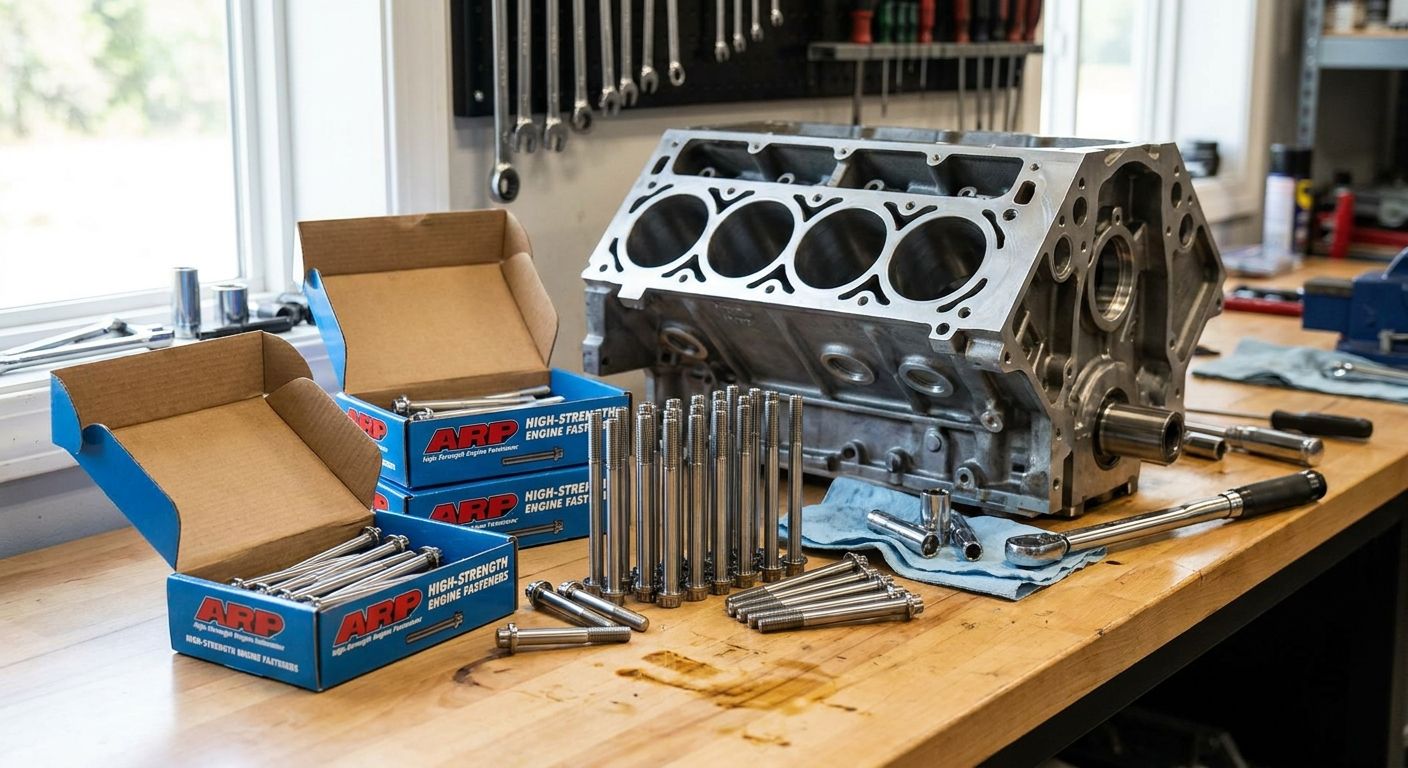
Picking the right ARP fasteners for a high horsepower LS engine build comes down to matching material spec to the joint's job: ARP2000 head studs cover naturally aspirated and moderate-boost combinations, ARP Custom Age 625+ studs step up for big-boost and nitrous applications, and dedicated ARP2000 main studs, ARP L19 rod bolts and accessory-drive bolts round out the rest of the bottom end. None of this is brand preference — it's tensile strength, thread engagement and clamping load matched to cylinder pressure and rpm.
- ARP2000 head studs (200,000 psi chromoly) suit naturally aspirated to moderate-boost LS engine builds.
- ARP Custom Age 625+ studs (260,000 psi) are the step-up once boost or nitrous raises cylinder pressure past what ARP2000 clamps reliably.
- ARP2000 main studs replace factory main bolts on stroker and priority-main-oiled LS blocks.
- ARP L19 rod bolts need a stretch gauge, not a torque wrench alone, for accurate high-rpm retention.
- Balancer and flexplate bolts matter as much as head studs once torque and rpm climb on an LS build.
Why this matters
Factory LS head bolts and main bolts are torque-to-yield, one-time-use fasteners sized for stock cylinder pressure and stock rpm. Add boost, nitrous, higher static compression or a stroker crank and the clamping load requirement on every major joint goes up with it.
Stud-style fasteners load more evenly than factory bolts because they thread into the block once and stay put — you torque the nut, not the bolt into aluminium or cast iron threads repeatedly. That matters most on head studs and main studs, where uneven clamping load shows up as head gasket failure or main cap movement long before you'd expect it in 2026-spec LS builds pushing real boost.
Spool Imports distributes ARP fasteners across the full LS range, alongside the pistons, rods and crankshafts they're built to clamp.
What makes the best ARP fastener kit for an LS build
- Tensile strength matched to expected cylinder pressure and rpm — not every joint needs 260,000 psi hardware
- Stud vs bolt design — studs remove repeated thread wear in the block and load more evenly than factory head bolts
- Torque method specified — torque-to-yield, straight torque, or stretch-gauge measurement, each requiring different installation practice
- Platform-specific fitment — LS1, LS2, LS3, LS7 and LSX blocks differ in deck thickness, thread pitch and stud length
- Corrosion resistance and lubricant compatibility — ARP moly lube is calibrated to their published torque specs, substituting oil changes the actual clamping load
- Application coverage — a kit built for a factory block bolt pattern won't necessarily suit an aftermarket LSX block
ARP fasteners for LS engines at a glance
| Fastener kit | Best for | Material / spec | Key limitation |
|---|---|---|---|
| ARP2000 Head Stud Kit | Naturally aspirated to moderate-boost LS builds | Chromoly, 200,000 psi | Not rated for extreme cylinder pressure at sustained high boost |
| ARP Custom Age 625+ Head Stud Kit | High-boost and nitrous LS combinations | Custom Age 625+ alloy, 260,000 psi | Overkill and unnecessary cost on a mild street LS |
| ARP2000 Main Stud Kit | Stroker and priority-main-oiled LS bottom ends | Chromoly, 200,000 psi | Requires block prep and correct stud length for the specific LS casting |
| ARP L19 Rod Bolt Kit | High-rpm connecting rod retention | L19 material, high fatigue resistance | Needs a stretch gauge for accurate installation, not a torque wrench |
| ARP Balancer & Flexplate Bolt Kit | High-torque accessory drive and drivetrain-side loads | ARP2000 chromoly | Easy to overlook on a build focused only on the short block |
1. ARP2000 Head Stud Kit: best for naturally aspirated and moderate-boost LS builds
ARP2000 head studs are chromoly fasteners rated at 200,000 psi tensile strength, built as a direct upgrade over the factory LS torque-to-yield head bolts. They thread into the block once and use a nut on the head side, which keeps clamping load consistent every time the heads come off for inspection.
For a street LS engine running factory or mildly increased boost, ARP2000 is the standard fastener spec most engine builders reach for before touching anything more exotic. Pair the stud kit with a head gasket matched to your bore size and deck surface — the Nason head gasket kit guide covers gasket selection for LS rebuilds in more detail.
ARP2000 head stud pros:
- Reusable without re-torquing to yield each time
- 200,000 psi tensile strength comfortably covers naturally aspirated and mild-boost cylinder pressure
- Straightforward torque installation with ARP moly lube
ARP2000 head stud cons:
- Not the fastener of choice once boost or nitrous pushes cylinder pressure well beyond factory-plus territory
- Requires correct stud length for your specific LS block and head combination
Verdict: Buy for naturally aspirated to moderate-boost LS builds.
2. ARP Custom Age 625+ Head Stud Kit: best for high-boost and nitrous LS combinations
Custom Age 625+ is ARP's higher-tensile alloy, rated at 260,000 psi. It's the head stud spec built for engines where cylinder pressure spikes hard and often — big single-turbo LS combinations, heavy nitrous shots, or anything running a static compression ratio pushed well past factory numbers.
The extra tensile strength doesn't change how the kit installs — it changes the safety margin under repeated high-cylinder-pressure events. On a build where head gasket sealing is already marginal from boost or compression, this is the fastener upgrade that buys back margin rather than the one that creates it.
ARP Custom Age 625+ pros:
- 260,000 psi tensile strength gives real margin on high-boost and nitrous LS combinations
- Same installation process as ARP2000, just higher-spec material
- Matches the clamping demands of aftermarket LSX blocks built for four-digit power
ARP Custom Age 625+ cons:
- Unnecessary cost on a mild street LS that never sees sustained high boost
- Doesn't fix a head gasket or deck surface problem on its own
Verdict: Buy once cylinder pressure and boost move well past a mild street tune — Skip on a naturally aspirated or light-boost combination where ARP2000 already covers the load.
3. ARP2000 Main Stud Kit: best for stroker and priority-main-oiled LS bottom ends
Main studs do for the bottom end what head studs do for the top end — they replace factory torque-to-yield main bolts with a reusable, evenly loaded fastener. On a stroker LS build with more rotating mass and a longer stroke, main cap movement under load becomes a real risk with factory hardware.
ARP2000 main studs are the standard spec here, rated at the same 200,000 psi as the head stud kit. Fitment differs by LS casting, so stud length and thread depth need to match the specific block — a factory LS3 block and an aftermarket LSX block are not interchangeable in this respect.
ARP2000 main stud pros:
- Even, repeatable clamping load across all main caps
- Reusable across multiple bottom-end rebuilds
- Matched tensile strength to ARP2000 head studs for a consistent fastener spec through the engine
ARP2000 main stud cons:
- Requires block prep specific to the casting and priority-main-oiling configuration
- Not a fix for a block with main cap walk already caused by undersized factory bolts
Verdict: Buy for any stroker LS build or engine running sustained high rpm.
4. ARP L19 Rod Bolt Kit: best for high-rpm connecting rod retention
Rod bolts see the highest cyclic load of any fastener in the engine — they're stretched and relaxed on every single revolution. ARP L19 material is built specifically for fatigue resistance under that kind of repeated cyclic stress, which is why it's the common spec on connecting rods built for sustained high rpm.
The critical detail with rod bolts is installation method. Torque wrenches measure friction as much as clamping load; a stretch gauge measures the actual elongation of the bolt, which is what determines real clamping force. Any high-rpm LS rotating assembly deserves the stretch-gauge method, not a torque spec alone.
ARP L19 rod bolt pros:
- High fatigue resistance suited to sustained high-rpm operation
- Stretch-gauge installation gives an accurate, repeatable clamping load
- Common spec across forged and billet connecting rod options for LS platforms
ARP L19 rod bolt cons:
- Stretch-gauge measurement adds a step (and a tool) most home builders skip
- Rod bolt spec needs to match the connecting rod manufacturer's design, not be swapped in isolation
Verdict: Buy for any LS build spinning past factory rpm limits — this isn't the fastener to cut corners on. The LS3 stroker kit guide covers rotating assembly selection for high-output LS3 builds where rod bolt spec matters most.
5. ARP Balancer & Flexplate Bolt Kit: best for high-torque accessory drive and drivetrain-side loads
The balancer bolt retains the entire harmonic balancer against crank snout torque every time the engine accelerates and decelerates. Flexplate or flywheel bolts do the same job at the clutch or torque converter interface. Both get overlooked on builds that pour attention into the short block and forget the joints either side of it.
ARP chromoly hardware here is rated at the same 200,000 psi tensile strength as the ARP2000 range, sized correctly for LS crank snout and flexplate bolt patterns rather than reusing factory hardware that was never designed for increased torque output.
ARP balancer/flexplate bolt pros:
- Correctly sized for increased torque loads at the crank snout and flexplate interface
- Cheap insurance relative to the damage a failed balancer bolt causes
- Straightforward, single-use torque installation
ARP balancer/flexplate bolt cons:
- Easy to forget when budgeting fasteners for a build focused on the short block
- Balancer bolt torque spec still depends on balancer design, not the bolt alone
Verdict: Buy on any LS build where power or torque output has increased meaningfully over factory.
How the ranking was done
Each fastener kit above is ranked against the criteria listed earlier: tensile strength matched to load, stud vs bolt design, torque method, platform fitment and corrosion resistance. No item competes for the same job — head studs, main studs, rod bolts and accessory bolts each solve a different joint, which is why this reads as a fastener specification list rather than a single leaderboard.
Which ARP fastener kit should you choose?
For a naturally aspirated or mild-boost LS build, ARP2000 covers the head studs and main studs, with L19 rod bolts if the build is spinning meaningful rpm. Once boost or nitrous pushes cylinder pressure well past that range, step the head studs up to Custom Age 625+ and keep the same L19 rod bolt spec underneath it.
Don't treat balancer and flexplate bolts as an afterthought — on a build where torque output has climbed, factory hardware there is as much a weak link as factory head bolts were before you upgraded them.
“If a fastener kit doesn't have a published torque or stretch spec for your specific LS block, you're guessing at clamping load, and cylinder pressure doesn't forgive guesses.”
Need help specifying LS fasteners?
Spool Imports stocks ARP kits across the LS platform range.
FAQ
What's the best ARP head stud for a turbo LS build?
ARP Custom Age 625+ head studs, rated at 260,000 psi, suit a turbo LS build once boost pushes cylinder pressure well past a mild street tune. ARP2000 studs at 200,000 psi cover naturally aspirated and moderate-boost combinations without the extra cost.
Are ARP2000 head studs strong enough for a built LS3?
Yes, for a naturally aspirated or moderate-boost LS3 build. Once the combination moves into high-boost or nitrous territory, Custom Age 625+ studs give more margin against repeated high cylinder pressure.
Do I need ARP main studs on a stock-bottom-end LS build?
Main studs matter most once you add a stroker crank, more rotating mass or sustained high rpm. A stock-bottom-end LS staying at factory power levels can usually run factory main bolts without issue.
How do you torque ARP rod bolts correctly?
ARP L19 rod bolts are best installed using a stretch gauge rather than a torque wrench alone, because stretch measures actual bolt elongation and clamping load. Torque figures vary by rod design, so always follow the connecting rod manufacturer's specification.
Is ARP Custom Age 625+ overkill for a naturally aspirated LS?
Yes. A naturally aspirated LS doesn't generate the sustained cylinder pressure that justifies the extra tensile strength, and ARP2000 already covers that load at a lower cost.
Can I reuse ARP head studs after removing the heads?
Yes, that's one of the main advantages of a stud-style fastener over factory torque-to-yield head bolts. Studs thread into the block once, so removing and refitting the heads doesn't require replacing the fastener.
Do ARP fasteners fit LS1, LS2, LS3 and LS7 the same way?
No. Deck thickness, thread pitch and stud length vary between LS castings, so the kit needs to match the specific block, not just the LS family name.
Do balancer and flexplate bolts matter on a high horsepower LS build?
Yes. Increased torque output loads the crank snout and flexplate interface more than factory levels, and factory hardware there wasn't designed for that increase.
One last thing
Most of the attention on a high horsepower LS build in 2026 goes to head studs, and rightly so — but rod bolts fail more often from incorrect installation than from being the wrong spec. A stretch gauge costs a fraction of a rebuild, and skipping one on a high-rpm rotating assembly is the single most avoidable mistake on this whole fastener list.