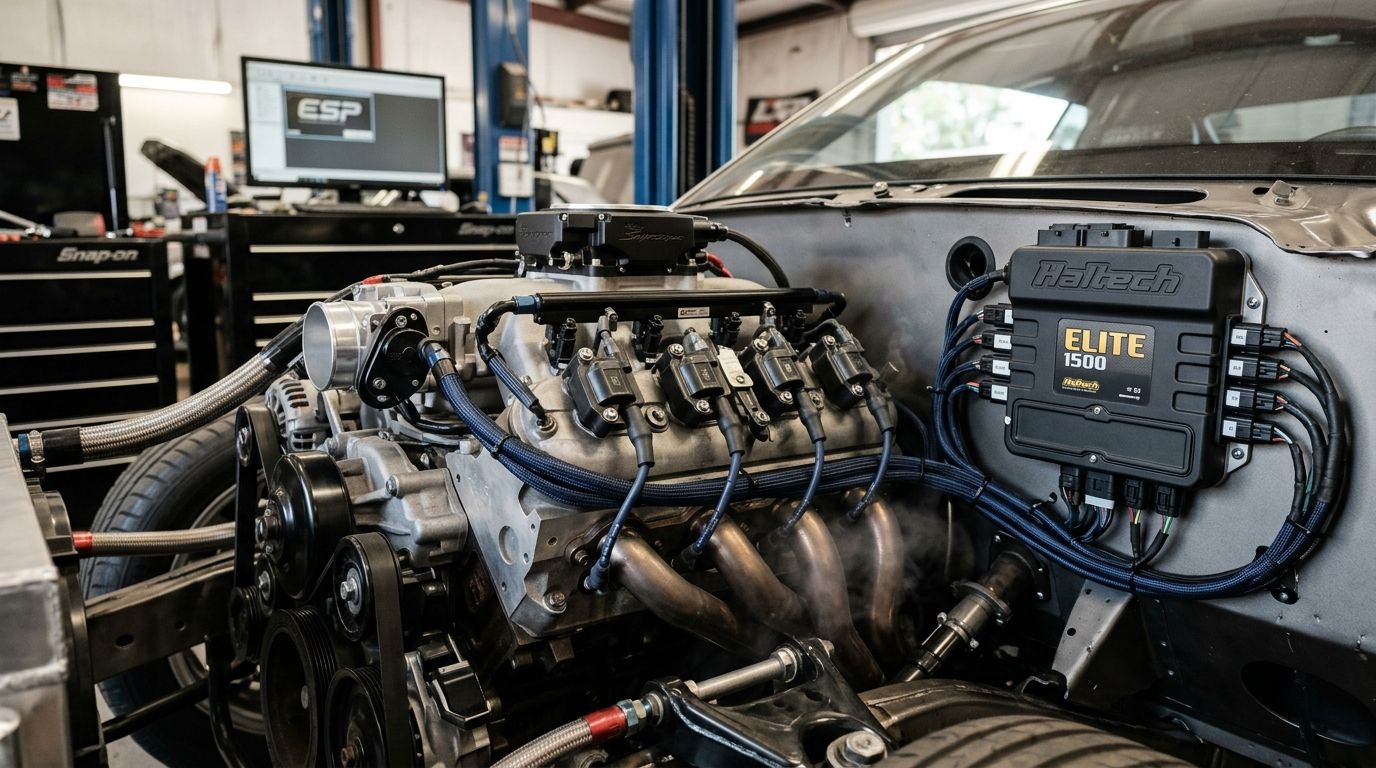
The Haltech Elite 1500 can run a V8 engine, but not in full per-cylinder sequential mode out of the box — it carries 6 onboard injector drivers and 6 onboard ignition drivers, one short of the 8 needed to fire and inject each cylinder independently on a V8.
- Haltech Elite 1500 has 6 onboard injector and ignition drivers, not 8, so a V8 needs semi-sequential injection or smart coils to run properly.
- Haltech Elite 2000 and Elite 2500 carry 8 onboard drivers each, matching a V8 natively without extra hardware.
- Semi-sequential injection pairs injectors on two cylinders per driver — a proven workaround, not a compromise that hurts a street or moderate-power build.
- Smart coils with built-in ignitors let an Elite 1500 fire 8 cylinders using low-level trigger signals instead of 8 dedicated high-current ignition outputs.
- For a V8 swap built around full sequential control from day one, the Elite 2000 is the simpler starting point in 2026.
Why this matters
Engine builders shopping the Haltech Elite range often assume ECU model numbers scale with cylinder count. They don't — the 1500 was built around 4 and 6-cylinder platforms, and running a V8 off it means understanding exactly which onboard resources you're short of before you commit to a wiring loom. Get this wrong at the quoting stage and you're re-pinning a harness or buying an expansion module halfway through the build.
Spool Imports distributes the full Haltech Elite lineup, and the same question comes up on RB, Barra and LS-based V8 conversions alike: can the cheaper ECU do the job, or do you need to step up a model. The answer comes down to driver count, not marketing.
Can a Haltech Elite 1500 run a V8 engine?
Yes, with a workaround. The Elite 1500 has 6 injector drivers and 6 ignition drivers built into the ECU. An 8-cylinder V8 needs either paired (semi-sequential) injection across two cylinders per driver, or smart coils that only need a low-current trigger signal rather than a dedicated high-current ignition driver per cylinder. Either approach lets the Elite 1500 control a V8; neither is required if you step up to a model with 8 onboard drivers.
Here's how the current Haltech Elite range compares for V8 applications in 2026, per the specs detailed in the Haltech ECU specs benchmark:
| ECU model | Onboard injector drivers | Onboard ignition drivers | V8 support |
|---|---|---|---|
| Haltech Elite 1500 | 6 | 6 | Needs semi-sequential injection and/or smart coils |
| Haltech Elite 2000 | 8 | 8 | Full sequential control, no extra hardware |
| Haltech Elite 2500 | 8 | 8 (plus expanded auxiliary I/O) | Full sequential control, more room for dry sump, traction control and extra sensors |
Verdict: the Haltech Elite 1500 is a workable V8 ECU for a street or moderate-boost build running semi-sequential injection, but a purpose-built V8 project is better served by the Elite 2000 or Elite 2500 from the start.
Haltech Elite 1500: 6 injector and 6 ignition drivers onboard
The Elite 1500 was engineered around 4 and 6-cylinder engines — think RB26, Barra, SR20 and similar. Its 6 onboard drivers cover those platforms with a driver per cylinder and true sequential control.
Drop it onto a V8 and you're two drivers short. Wiring the injectors in pairs (cylinder 1 and 5 sharing a driver, for example) gets you semi-sequential injection, which fires two injectors together instead of one at a time. For street and mid-power turbo or naturally aspirated V8 builds this is a well-proven setup, not a stopgap that hurts drivability.
Ignition is the other constraint. Standard high-output coils need a dedicated ignition driver each, so an 8-cylinder engine needs 8 drivers unless you switch to smart coils — coils with the ignitor built in, triggered by a simple low-current signal the Elite 1500 can multiplex across its existing outputs.
Buy if: you're running a street or moderate-power V8 and are happy wiring semi-sequential injection with smart coils. Skip if: you want per-cylinder sequential control without touching the wiring plan.
Haltech Elite 2000: 8 drivers built for V8 sequential control
The Elite 2000 carries 8 onboard injector drivers and 8 onboard ignition drivers, matching a V8 cylinder-for-cylinder without an expansion module or smart coil workaround. It's the natural step up when a build is planned as a V8 from the outset rather than adapted from a smaller-ECU parts bin.
For engine builders running LS, Coyote or similar V8 platforms who want full sequential injection and ignition with a straightforward loom, the Elite 2000 removes the driver-count conversation entirely.
Buy if: the engine is a V8 from day one and you want native sequential control. Skip if: budget is tight and semi-sequential injection on an Elite 1500 already covers your power target.
Haltech Elite 2500: 8 drivers plus expanded auxiliary I/O
The Elite 2500 matches the Elite 2000's 8 injector and 8 ignition drivers but adds more auxiliary inputs and outputs — headroom for dry sump oil pressure control, traction control strategies, extra wideband inputs and additional sensor channels. The full breakdown against the 1500 and 2000 sits in is a Haltech Elite 2500 worth it.
For a race-oriented V8 build layering in dry sump control, boost-by-gear or CAN-based dash and keypad integration, the extra I/O on the Elite 2500 avoids running out of channels mid-project.
Buy if: the V8 build includes dry sump, traction control or multiple CAN accessories. Skip if: the engine is a straightforward street V8 — the Elite 2000's 8 drivers already cover it.
Why the driver count decision varies build to build
- Injection strategy — semi-sequential is fine for street and moderate boost; full sequential matters more as fuel demand and idle quality get pushed to their limits.
- Coil type — smart coils free up ignition drivers on the Elite 1500; standard high-output coils need one driver per cylinder.
- Auxiliary functions — dry sump control, traction control and extra CAN devices eat into spare inputs/outputs faster than most builders expect.
- Wiring loom complexity — pairing injectors or adding smart coils changes the harness design compared with a straight 8-driver setup.
- Expansion hardware — an external ignition or injector expansion module can add drivers to a lower-tier ECU, at the cost of extra wiring and a second component to fault-find.
- Tuning plan — a tuner comfortable calibrating semi-sequential fuel maps makes the Elite 1500 route far less of a compromise on a street V8.
“An Elite 1500 wired for a V8 without smart coils is still a six-driver ECU pretending to run eight cylinders.”
Do I need smart coils to run a V8 on a Haltech Elite 1500?
Smart coils solve the ignition side of the Elite 1500's 6-driver limit by using a low-current trigger signal instead of a dedicated high-current ignition driver per cylinder. Without them, you're limited to sharing ignition drivers across cylinder pairs, which works but adds complexity to the timing strategy on a V8.
What's the difference between a Haltech Elite 1500 and Elite 2500?
6 onboard injector and ignition drivers on the Elite 1500 versus 8 of each on the Elite 2500, plus meaningfully more auxiliary I/O on the 2500 for dry sump, traction control and extra CAN accessories. The Elite 1500 suits 4 and 6-cylinder platforms natively; the Elite 2500 suits V8 builds with layered auxiliary functions.
Is semi-sequential injection a problem for a V8 build?
Semi-sequential injection is not a problem for street or moderate-power V8 builds — it's a proven, widely used method that pairs injectors two-to-a-driver. It becomes a limiting factor only on builds chasing the last percentage of idle refinement or extreme fuel demand where true per-cylinder sequential timing earns its keep.
Getting the crank trigger side of a V8 Haltech install right matters just as much as driver count — see the crank trigger kit for a Haltech ECU install for what the ECU expects from the signal side before it ever gets to injector or ignition timing.
Spool Imports stocks the Haltech Elite range as a Haltech distributor, alongside the looms, crank trigger kits and expansion hardware that turn a driver-count shortfall into a solved wiring problem rather than a roadblock.
Sorting Haltech wiring for a V8 swap?
See how workshops handle Elite ECU tuning on V8 conversions.
FAQ
Can a Haltech Elite 1500 control a V8 engine?
Yes, the Haltech Elite 1500 can control a V8, but it needs semi-sequential injection or smart coils because it only has 6 onboard injector and ignition drivers against the V8's 8 cylinders. Full per-cylinder sequential control needs an Elite 2000 or 2500.
How many injector drivers does the Haltech Elite 1500 have?
The Haltech Elite 1500 has 6 onboard injector drivers and 6 onboard ignition drivers. That covers 4 and 6-cylinder engines natively, and a V8 with paired injection.
Do I need smart coils to run a V8 on a Haltech Elite 1500?
Smart coils are the simplest way to run full ignition control on a V8 with an Elite 1500, since they use a low-current trigger signal instead of a dedicated ignition driver per cylinder. Without smart coils you're sharing ignition drivers across cylinder pairs.
Can the Haltech Elite 2000 run a V8 in full sequential mode?
Yes, the Haltech Elite 2000 has 8 onboard injector and ignition drivers, matching a V8 cylinder-for-cylinder without smart coils or an expansion module.
Which Haltech ECU is best for a V8 swap, the Elite 1500 or Elite 2000?
The Elite 2000 is the simpler choice for a V8 swap because its 8 onboard drivers match the engine natively. The Elite 1500 works too on a street build once wired for semi-sequential injection and smart coils.
Is semi-sequential injection a problem on a V8 build?
Semi-sequential injection is not a problem for street or moderate-power V8 builds and is a proven method used across the industry. It only becomes a limiting factor on builds chasing extreme idle refinement or fuel demand.
What's the difference between a Haltech Elite 1500 and Elite 2500 for a V8?
The Elite 2500 has 8 onboard injector and ignition drivers plus significantly more auxiliary inputs and outputs compared with the Elite 1500's 6 drivers of each. The 2500 suits V8 builds layering in dry sump control, traction control or extra CAN accessories.
Can you tune a Haltech Elite 1500 yourself on a V8 build?
Tuning a Haltech Elite 1500 on a V8 is possible for an experienced tuner comfortable with semi-sequential fuel maps and smart coil ignition setup. A straightforward Elite 2000 install with native 8-driver sequential control is generally the easier self-tune path.
One last thing
The detail most builders miss isn't the driver count — it's that stepping up from the Elite 1500 to the Elite 2000 doesn't just add drivers, it removes an entire category of wiring decisions from the project. If the plan was always a V8, matching the ECU to the cylinder count from the start in 2026 saves a re-wire later.