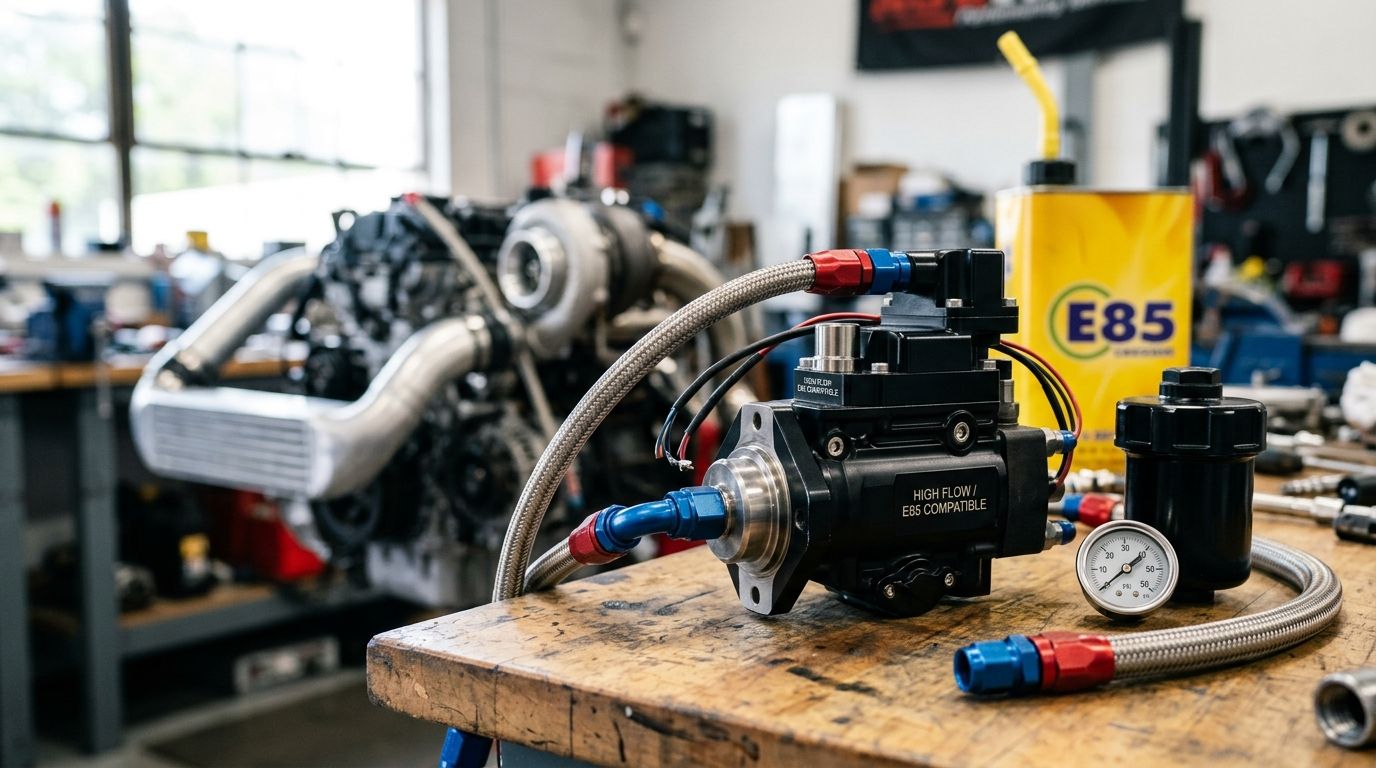
Running E85 through a turbocharged engine changes the fuel pump conversation completely — ethanol needs more volume, different wetted materials, and a pump built to survive it. The best fuel pump for an E85 turbo build depends on whether you're running a single high-flow unit, a staged twin-pump setup, or an external surge-tank system, and this guide breaks down five commonly used options by the job each one actually does.
- Walbro F90000267 (450 brushless) wins for single-pump high-flow E85 builds that need one pump to do the whole job.
- DeatschWerks DW400 suits staged twin-pump fuel systems where flow needs to hold up as rail pressure climbs.
- Bosch 044 remains the standard external pump for surge-tank-fed high-boost combinations.
- Walbro GSS342 (450) covers factory in-tank swaps on street builds, but check its ethanol rating before running it full-time on E85.
- AEM 50-1200 E85 High Flow suits tight OEM tank clearance where factory-fit, ethanol-specific internals matter more than raw flow.
Why this matters
E85 carries less energy per litre than pump fuel, so the same power target needs meaningfully more fuel volume flowing through the rail — commonly cited at around 30% more by volume than an equivalent petrol tune. A pump sized correctly for a 98-octane build can fall short the moment you switch to E85, even if the injectors and ECU tune are otherwise sorted.
Ethanol also attacks pump internals that were never designed for it. Brush material, seals and internal coatings that hold up fine on petrol can wear out fast on E85, so flow rate is only half the selection problem — chemical compatibility is the other half. If you're finishing out a forged piston build for E85, the fuel system needs the same attention as the bottom end.
What makes the best fuel pump for an E85 turbo build
- Flow rate at your actual rail pressure — not the peak number printed on the box
- E85 material compatibility — seals, brush type and wetted internals rated for ethanol, not just petrol
- Voltage and current draw matched to your wiring, relay and PDM capacity
- Mounting fit — in-tank drop-in versus external or surge-tank installation
- Headroom to add a second pump or surge tank as boost and power climb
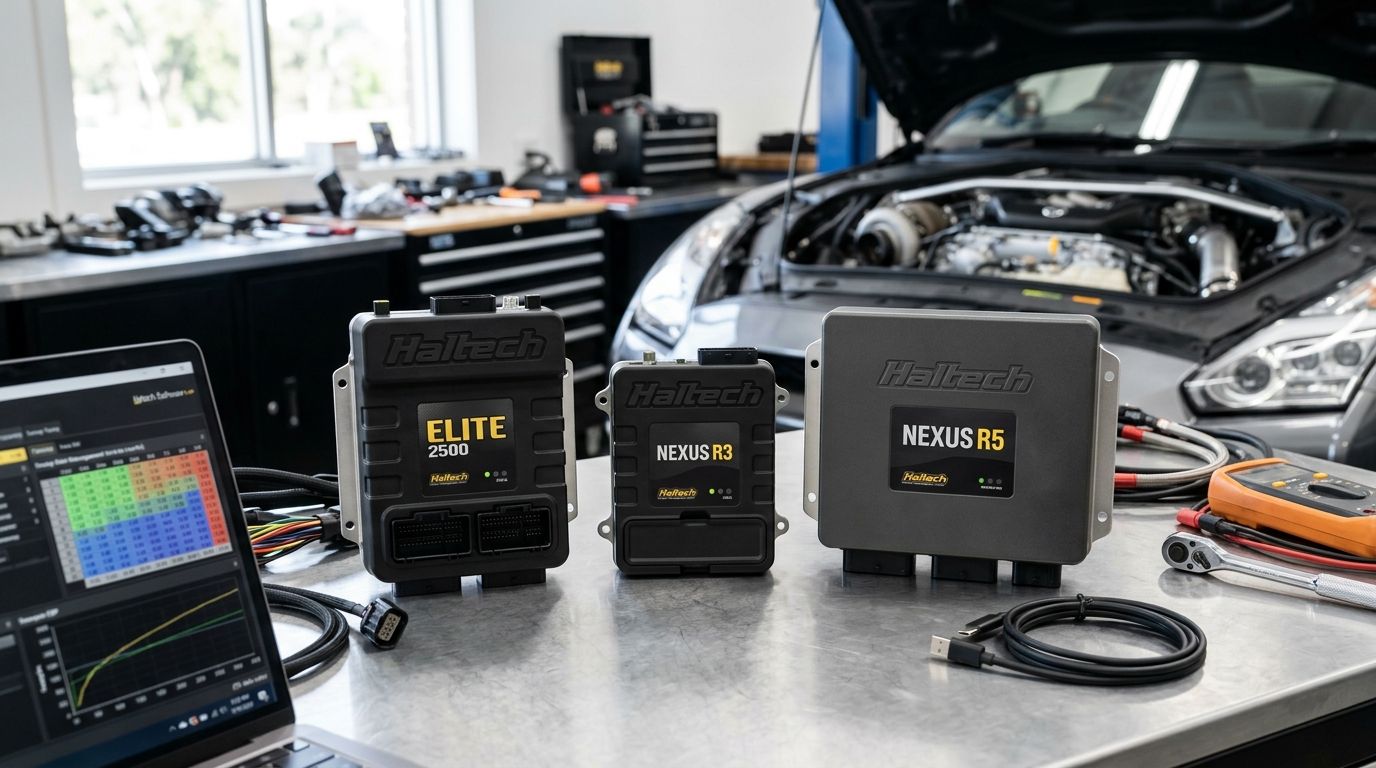
- Compatibility with ECU pump speed control, where a PWM-driven pump like those run through Haltech engine management can vary flow instead of running flat-out at idle
Fuel pumps at a glance
| Pump | Best for | Standout feature | Key limitation |
|---|---|---|---|
| Walbro F90000267 (450 brushless) | Single-pump high-flow E85 builds | Brushless motor rated for continuous E85 use | Highest current draw of the group — needs a dedicated relay or PDM circuit |
| DeatschWerks DW400 | Staged or twin-pump fuel systems | Flat flow curve as rail pressure climbs | Needs a second pump or surge tank to cover big-turbo demand alone |
| Bosch 044 (0 580 254 044) | External surge-tank-fed systems | Decades of proven flow under sustained boost | Not designed for in-tank mounting — adds plumbing complexity |
| Walbro GSS342 (450) | Factory in-tank swap on street builds | Drop-in fit for many factory tank hangers | Brushed motor design — confirm the ethanol rating before running it full-time on E85 |
| AEM 50-1200 E85 High Flow | Tight OEM tank clearance with E85-specific internals | Ethanol-compatible seals from the factory | Narrower in-tank fitment range than a universal external pump |
1. Walbro F90000267: best fuel pump for single-pump high-flow E85 builds
The F90000267 is Walbro's brushless in-tank pump, rated around 450 litres per hour and built specifically to handle E85's lower lubricity without the brush wear that shortens the life of older brushed designs. It's the go-to choice when you want one pump to carry the whole fuel demand rather than staging a second unit in.
Walbro F90000267 pros:
- Brushless design rated for continuous E85 duty, not just occasional flex-fuel use
- High single-pump flow removes the need for a staged second pump on most street-turbo builds
- Widely supported by aftermarket fuel hangers and drop-in kits
Walbro F90000267 cons:
- Draws more current than brushed alternatives, so wiring and relay sizing need to match
- Runs hotter under sustained high-flow conditions than a lightly loaded twin-pump setup
Walbro F90000267 pricing: check current pricing and stock through your preferred fuel system supplier.
Best for: builds that want a single pump to cover the whole E85 fuel demand without staging. Verdict: Buy if your fuel system architecture supports one in-tank pump and your wiring can carry the current draw.
2. DeatschWerks DW400: best fuel pump for staged twin-pump fuel systems
The DW400 is commonly run in staged setups where a second pump switches on at higher demand, because its flow curve stays relatively flat as rail pressure rises rather than tapering off hard. That behaviour matters more in a twin-pump system than raw peak flow does.
DeatschWerks DW400 pros:
- Holds flow well as boost and rail pressure climb, rather than dropping off early
- Compact in-tank form factor suits factory hanger conversions
- Common choice for staged controllers that add a second pump under load
DeatschWerks DW400 cons:
- On its own, doesn't match the peak flow of a brushless 450-rated pump
- Best value comes from a staged setup, which adds wiring and control complexity
DeatschWerks DW400 pricing: confirm current pricing through your fuel system supplier.
Best for: twin-pump fuel systems where flow consistency under rising pressure matters more than one pump's peak number. Verdict: Buy for staged setups; Hold if you're only running a single pump.
3. Bosch 044: best fuel pump for external surge-tank-fed systems
The Bosch 044 has been a fixture in external and surge-tank fuel systems for decades, commonly rated around 300 litres per hour at 3 bar. It's not an in-tank pump — it's designed to be plumbed externally, usually fed by a surge tank or swirl pot that keeps it supplied under hard cornering and heavy fuel draw.
Bosch 044 pros:
- Long track record in high-boost motorsport fuel systems
- Consistent flow under sustained high-demand conditions
- Rebuildable and widely supported by external fuel system components
Bosch 044 cons:
- Requires external plumbing, mounting and a surge tank or swirl pot — more complexity than a drop-in in-tank pump
- Not a fit for builds wanting to keep the fuel system entirely inside the factory tank
Bosch 044 pricing: check current pricing through your fuel system supplier.
Best for: dedicated external or surge-tank fuel systems, particularly track and drag builds already running a swirl pot. Verdict: Buy if you're building an external system; Skip if you want to stay in-tank.
4. Walbro GSS342 (450): best fuel pump for a factory in-tank swap on street builds
The GSS342 is one of the most common drop-in fuel pump upgrades on street turbo cars, fitting a wide range of factory tank hangers without modification. It's a brushed design, which means its ethanol tolerance is a real question mark for full-time E85 duty rather than occasional flex-fuel top-ups.
Walbro GSS342 pros:
- Drop-in fit for many factory tank hangers with no fabrication
- Familiar, well-documented wiring and mounting across common platforms
- Solid choice for mixed petrol/E85 use where E85 isn't run continuously
Walbro GSS342 cons:
- Brushed motor design wears faster on E85 than brushless alternatives
- Not the pump to reach for if the plan is full-time E85 running
Walbro GSS342 pricing: confirm current pricing and E85 rating with your supplier before ordering.
Best for: street builds running E85 occasionally alongside pump fuel rather than full-time. Verdict: Hold for occasional E85 use; Skip for a dedicated full-time E85 build.
5. AEM 50-1200 E85 High Flow: best fuel pump for tight OEM tank clearance with E85-specific internals
AEM's E85 High Flow in-tank pump is built with ethanol-compatible seals and internals from the factory rather than as a petrol pump adapted after the fact. It fits a narrower range of factory tank hangers than a universal pump, so mounting fit needs checking against your specific tank before ordering.
AEM 50-1200 pros:
- Ethanol-specific internals designed for E85 from the outset
- In-tank fitment keeps the fuel system simple compared to external setups
- No brush-wear question mark that comes with converted petrol pumps
AEM 50-1200 cons:
- Narrower factory hanger compatibility than a universal-fit pump
- Flow sits below the top brushless options, so big single-pump combinations may need to look elsewhere
AEM 50-1200 pricing: check current pricing and tank compatibility with your supplier.
Best for: builds that want factory-fit, E85-specific internals without external plumbing. Verdict: Buy where tank compatibility checks out.
How we ranked these
Each pump was placed against the criteria above rather than a single leaderboard: flow behaviour at real rail pressure, documented E85 material compatibility, mounting fit, wiring load, and whether it suits a single-pump or staged architecture. That's why the list reads as a decision tree by use case rather than a straight best-to-worst order — a Bosch 044 external pump and a Walbro GSS342 in-tank swap aren't competing for the same job.
Which fuel pump should you choose?
For most dedicated E85 turbo builds running a single pump, the Walbro F90000267 is the safest default — it's rated for continuous E85 use and flows enough to cover most street and strip combinations without staging. If you're already committed to a staged twin-pump architecture, the DeatschWerks DW400 fits that role well. Builds running an external surge tank should stay with the Bosch 044, and anyone only running E85 occasionally can get away with the Walbro GSS342 provided the ethanol rating checks out for the duty cycle.
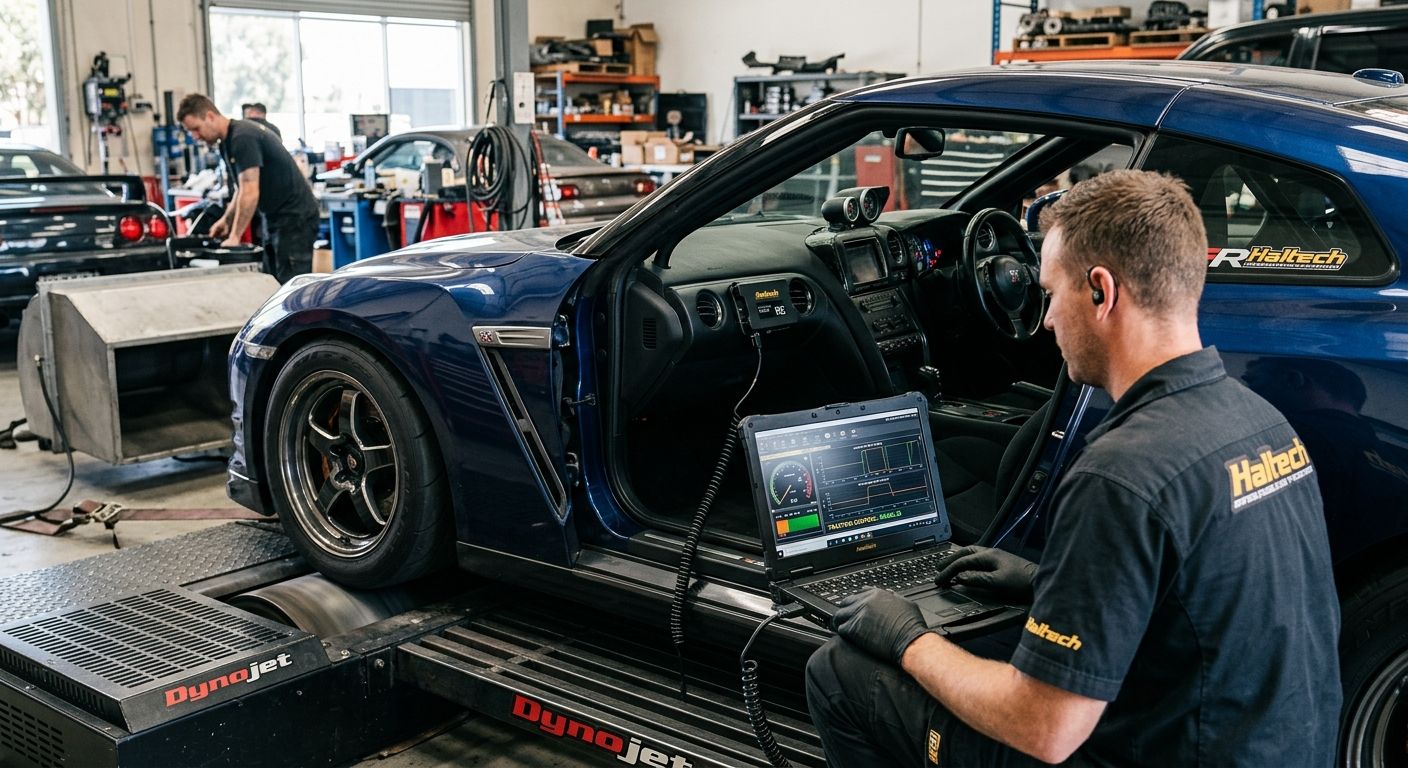
Pair whichever pump you land on with an ECU that can control it properly — a Haltech ECU platform with pump speed control gets more life out of any of these options than running them flat-out on a simple relay.
Get help matching your fuel system
Talk to Spool Imports before locking in a pump, injector and ECU combination.
FAQ
What's the best fuel pump for an E85 turbo build?
For most single-pump E85 turbo builds, the Walbro F90000267 (450 brushless) is the safest default because it's rated for continuous E85 use and flows around 450 litres per hour. Staged twin-pump systems commonly use the DeatschWerks DW400 instead.
Is the Walbro 450 E85 compatible?
The brushless Walbro F90000267 is built for continuous E85 use, but the older brushed Walbro GSS342 (also marketed as a 450) has a brushed motor whose ethanol tolerance is a real question for full-time E85 duty. Confirm which version you're buying before committing to full-time E85.
How much fuel pump flow do I need for E85?
E85 needs roughly 30% more fuel by volume than petrol for the same power target because it carries less energy per litre. Size flow rate against your actual rail pressure and target power, not the peak number printed on the pump.
Can I run a single Bosch 044 on E85?
Yes, the Bosch 044 is commonly run on E85 in external, surge-tank-fed systems rated around 300 litres per hour at 3 bar. It's not an in-tank pump, so it needs a surge tank or swirl pot and external plumbing.
Do I need two fuel pumps for an E85 turbo build?
Not always — a single brushless pump like the Walbro F90000267 covers most street and strip E85 combinations on its own. Staged twin-pump setups make more sense on builds where fuel demand varies widely between cruise and full boost.
Does E85 need a bigger fuel pump than petrol?
Yes, because E85 has lower energy density than petrol, the same power output needs more fuel volume flowing through the rail. A pump correctly sized for a petrol tune can fall short once the car is switched to E85.
Is the DW400 better than the Walbro 450 on E85?
Neither is universally better — the DW400 holds a flatter flow curve as rail pressure climbs and suits staged twin-pump systems, while the brushless Walbro F90000267 covers more single-pump E85 builds on its own with higher peak flow.
What voltage does an E85 fuel pump need?
Most aftermarket E85 pumps run on standard 12-volt automotive electrical systems, but current draw is higher than petrol-only pumps, so wiring, relays and PDM circuits need to be sized for the specific pump's rated draw.
One last thing
E85 isn't a fixed blend — ethanol content in commercially available E85 can range from around 51% to 83% depending on season and region, which shifts the actual fuel volume your combination needs from one fill-up to the next. That variance is a bigger factor in real-world fuel pump sizing in 2026 than most build sheets account for, and it's worth confirming your local E85 spec before finalising pump and injector sizing rather than assuming a single fixed ratio.