
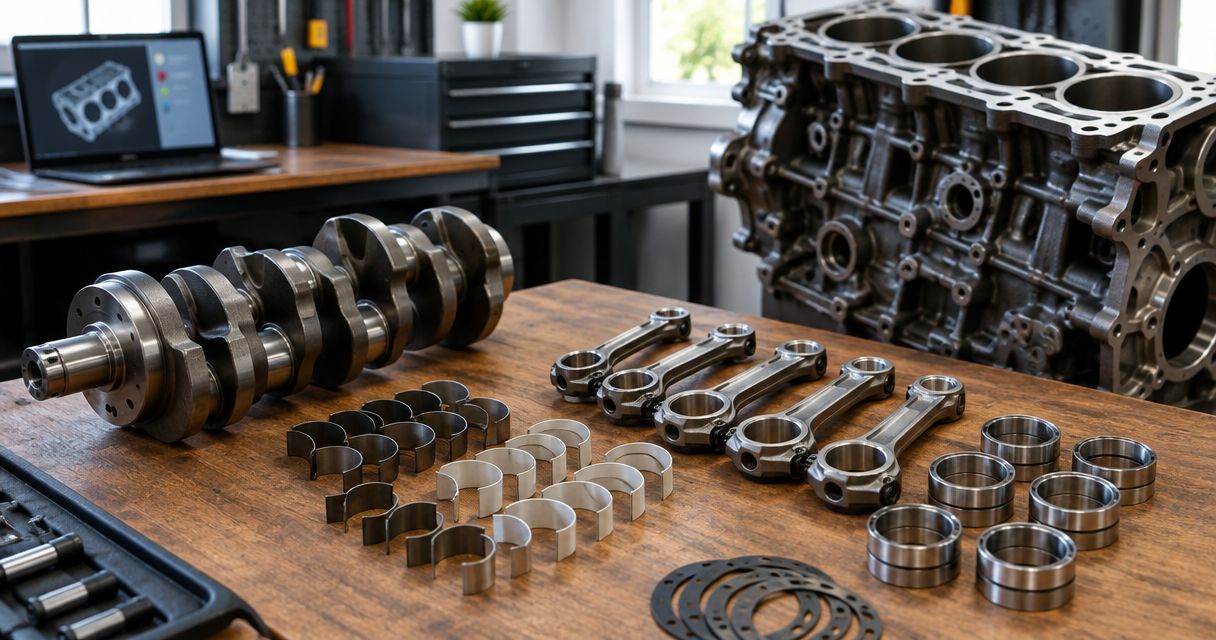
An engine rebuild kit can include pistons, rings, conrods, bearings, gaskets and fasteners, but the name does not guarantee a crankshaft or a complete engine assembly. For a 2026 rebuild, choose the kit from its itemised contents and confirmed dimensions, then account separately for machining, inspection and any components you intend to reuse.
- An engine rebuild kit is a parts package, not a guarantee that every replacement component is included.
- Choose crankshafts, conrods and engine bearings from measured dimensions, intended use and manufacturer instructions.
- Spool Imports supplies SPOOL rebuild components, CP-Carrillo products, ACL Race Series bearings and ARP fasteners.
- Confirm piston size and bearing selection with your engine machinist before finalising the kit.
Why this matters
A kit can simplify purchasing, but it cannot establish the condition of your block, crankshaft or cylinder head. Ordering before inspection risks buying components that do not suit the finished machining dimensions.
Spool Imports supplies engine rebuild components for workshops and builders who need component-selection advice as well as parts. The Spool Imports range includes internal engine components, but the correct combination still depends on the engine you are assembling.
Treat the kit as an itemised supply package. Treat the rebuild as a separate engineering job with its own inspection, machining and assembly requirements.
What's in an engine rebuild kit?
An engine rebuild kit contains the components listed for that particular package. There is no universal contents list, and terms such as rebuild kit, bottom-end kit and stroker kit should not replace a written bill of materials.
Use this table to check what a proposed package covers. These are component categories to verify, not a statement that every kit contains them.
| Component | What to establish before ordering | Limitation to account for |
|---|---|---|
| Pistons | Finished bore size, compression height, crown configuration and pin fitment | Engine-family fitment alone does not confirm suitability |
| Piston rings | Compatibility with the selected piston and finished bore | Ring fitting remains an assembly task |
| Conrods | Centre-to-centre length, journal fitment, pin fitment and fastener instructions | Beam shape alone does not establish suitability |
| Crankshaft | Inclusion, stroke, journal dimensions and engine interfaces | A rebuild kit need not include a crankshaft |
| Main and conrod bearings | Journal size, housing dimensions, bearing design and measured clearance | An application listing does not establish assembled clearance |
| Gaskets and seals | Exact engine variant, sealing interfaces and individual inclusions | A gasket package need not cover every external seal |
| Fasteners | Included locations, part numbers and installation instructions | Existing fasteners require a separate reuse assessment |
| Thrust components | Engine arrangement and whether supplied separately or with bearings | Inclusion and configuration require checking |
Ask for part numbers as well as descriptions. A line reading “performance bearings” gives you less useful information than the exact bearing set and size designation.
For your 2026 parts order, distinguish supplied, reused and ordered separately. That simple separation exposes omissions before the engine reaches assembly.
Rebuild kit, rotating assembly or stroker kit?
These packages answer different purchasing needs. Compare their itemised contents rather than assuming that one label means a more complete engine.
| Package | Suits | Selection advantage | Limitation |
|---|---|---|---|
| Engine rebuild kit | Replacing the internal service components identified during inspection | Groups rebuild parts into a single purchasing package | Contents vary; machining and ancillary components remain separate checks |
| Rotating assembly | Selecting crankshaft, conrods and pistons as a combination | Lets you assess the rotating components together | Confirm bearings, rings, balancing requirements and sealing parts separately |
| Stroker kit | A build designed around a changed crankshaft stroke | Focuses component selection on the intended geometry | Requires checks beyond displacement, including physical clearance |
A retained crankshaft can be appropriate when its condition, dimensions and suitability are confirmed. A replacement crankshaft is a separate decision, not an automatic requirement because you are rebuilding the engine.
Do not select a stroker package solely because it changes capacity. Confirm that the crankshaft, conrods and pistons form a workable combination within your block and cylinder head arrangement.
How to choose the crankshaft
Start with the existing crankshaft inspection. Establish journal condition, dimensions and the engine machinist's assessment before deciding whether to retain, machine or replace it.
For a replacement crankshaft, check:
- Stroke: confirm the intended rotating-assembly geometry.
- Journals: match main and conrod journal dimensions to the block, rods and bearings.
- Interfaces: confirm the crank nose, flywheel or flexplate attachment, timing drive and trigger arrangement.
- Clearance: check the rotating assembly against the block and surrounding components.
- Balancing: establish what balancing work the complete combination requires.
SPOOL billet crankshafts are a product family to consider when a replacement crankshaft is part of the build. Their suitability depends on the exact application and dimensions; billet construction does not remove any fitment or assembly checks.
The advantage of retaining a suitable crankshaft is that you preserve an established engine interface. The limitation is its existing condition and geometry. A replacement offers a different component choice, but brings its own interface, clearance and balancing requirements.
Use the billet crankshaft selection guide to organise those checks before choosing the rest of the rotating assembly.
How to choose conrods without relying on beam shape
Conrod selection starts with dimensions and application requirements, not an H-beam versus I-beam verdict. Establish rod length, big-end dimensions, small-end fitment, side clearance requirements and the supplied fastener procedure.
The following comparison separates confirmed product identities from the specifications you must check for your engine.
| Product family | Confirmed description | Suits consideration when | Specification-led selection check | Limitation |
|---|---|---|---|---|
| SPOOL H-Beam conrods | SPOOL-branded forged H-Beam connecting rods | You are assessing a SPOOL rod option for the rotating assembly | Verify application, dimensions and bolt instructions | The H-Beam label alone is not a load rating |
| SPOOL X300 300M I-Beam conrods | SPOOL-branded 300M I-Beam connecting rods | You are comparing the specified material and rod design against your build requirements | Verify the exact application and complete rod specification | Material and beam description do not establish compatibility |
| CP-Carrillo connecting rods | Connecting rods from a brand distributed by Spool Imports | You are comparing an alternative manufacturer's rod specification | Check the exact model, dimensions, material and fastener procedure | Brand identity alone does not determine suitability |
Compare exact rod specifications, not brand reputation or the appearance of the beam. A meaningful comparison requires equivalent application information and the installation instructions for each option.
Keep the rod bolts in that assessment. Bolt lubricant, tightening method and any stretch procedure belong to the specific fastener instructions; they are not interchangeable workshop assumptions.
How to choose main and conrod bearings
Bearing selection depends on the crankshaft journals and the housings in which the bearings operate. Confirm the block's main bearing arrangement, conrod big-end dimensions, journal measurements and the selected bearing manufacturer's instructions.
ACL Race Series bearings are among the bearing products supplied by Spool Imports. Select the exact application and size designation, then verify assembled clearance rather than treating the product name as a clearance specification.
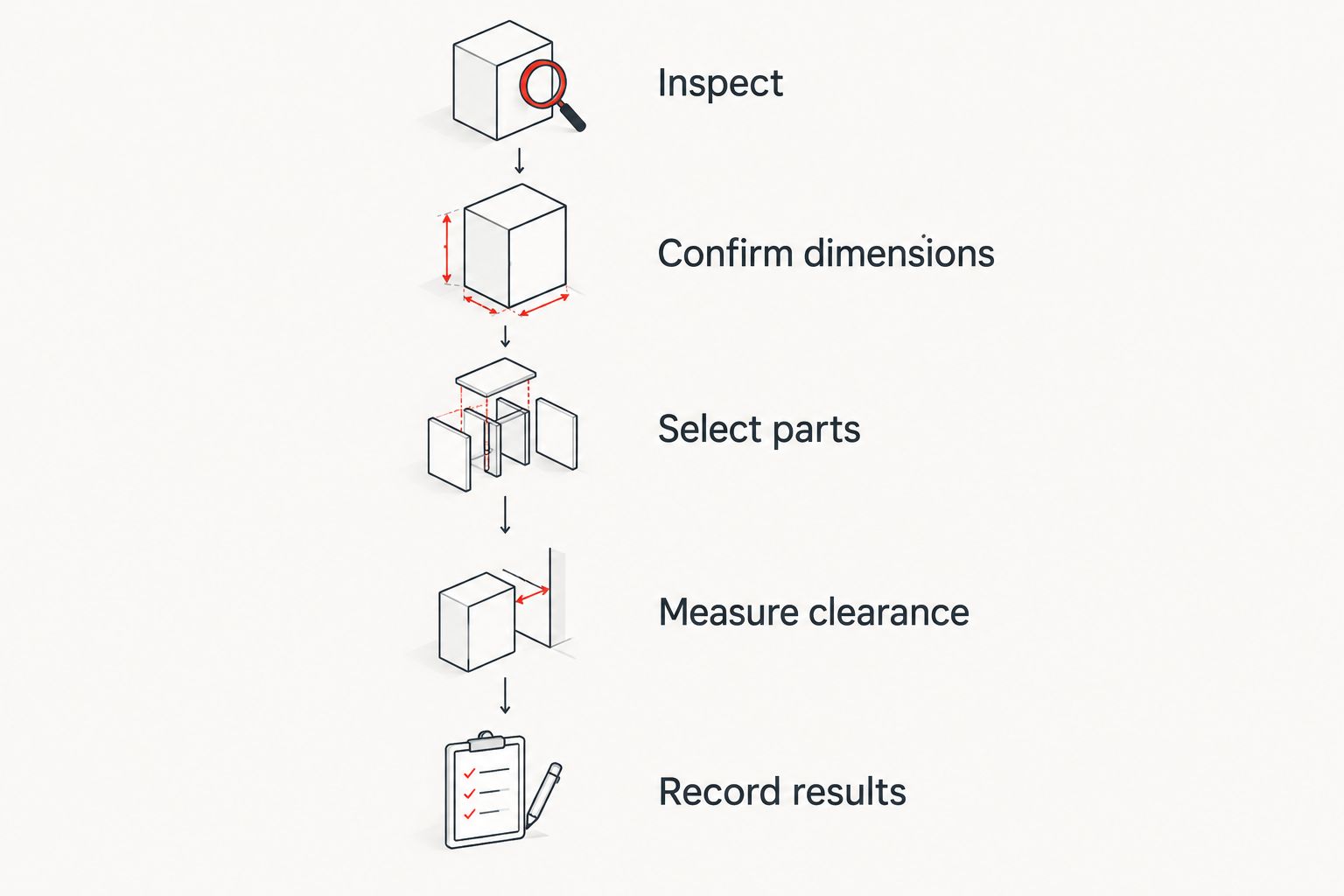
Use this sequence:
- Inspect: assess the crankshaft, block and conrods before choosing final sizes.
- Confirm dimensions: record the machining requirements and the dimensions that will govern selection.
- Select parts: choose the bearing application and size designation for those dimensions.
- Measure clearance: measure the assembled arrangement using an appropriate workshop procedure.
- Record results: retain the measurements and manufacturer references with the build sheet.
This sequence keeps bearing purchasing tied to the actual engine. A catalogue match is necessary, but it is not a substitute for measuring the assembled components.
For a 2026 workshop build sheet, record each measured clearance against its component location. Keep the bearing part number and size designation beside those results so the assembly record remains traceable.
Do not choose additional-clearance bearings as a general upgrade. A different bearing specification is appropriate only when it produces the intended clearance in the measured assembly.
Pistons, gaskets and fasteners must match the combination
Piston choice depends on more than the bore diameter. Compression height, pin fitment, crown configuration, ring package and the relationship between stroke and rod length all affect the assembly.
Confirm the piston manufacturer's required bore clearance and ring instructions before final machining and assembly. Do not transfer a clearance or ring-gap specification from another piston simply because both products fit the same engine family.
Spool Imports distributes CP-Carrillo products, Cometic and Athena gaskets, and ARP fasteners. These component families address different jobs; none should be selected as a substitute for confirming the relevant dimensions and installation requirements.
For gaskets, check the exact engine variant, bore compatibility, thickness and the required sealing-surface preparation. For fasteners, check the intended location, engagement, lubricant and tightening procedure.
The purchasing advantage is access to component families for several parts of the rebuild. The limitation is that cross-brand compatibility remains a build-specific responsibility: a recognised name on each box does not establish a matched system.
Why engine rebuild kit contents vary
Kit contents vary because the engine and the work required are not identical from one rebuild to the next. These factors determine what belongs in the package:
- Engine variant: changes in component interfaces require exact application checks.
- Existing condition: inspection determines which parts can remain and which require replacement.
- Machining outcome: finished bore and journal dimensions govern the replacement parts.
- Rotating-assembly design: retained stroke and changed stroke require different geometry checks.
- Intended use: duty, operating conditions and the planned combination guide component selection.
- Included systems: a bottom-end package does not automatically cover cylinder-head, oiling or timing components.
Your 2026 kit comparison should use the same checklist for every supplier. Otherwise, you are comparing package names rather than equivalent contents.
Does an engine rebuild kit include a crankshaft?
An engine rebuild kit includes a crankshaft only when the itemised contents specify one. Ask whether the proposed package assumes reuse of your existing crankshaft and which bearings suit its final journal dimensions.
If you need a replacement, confirm the crankshaft specification before finalising the rods, pistons and bearings. Those decisions are connected.
Can you reuse parts that are not included in the kit?
You can reuse a component only after its condition and suitability have been assessed. Being absent from the kit is not evidence that an oil pump, timing component, fastener or crankshaft is fit for continued service.
Make reuse decisions during inspection. Record the decision separately from the purchasing list so an omitted part does not become an accidental reuse decision.
Before you order the rebuild kit
Send your supplier and engine machinist the same build information. Include the exact engine variant, intended use, proposed crankshaft stroke, conrod and piston choices, known machining requirements and the components you plan to retain.
For a 2026 parts enquiry, request an itemised package with exact part numbers and size designations. Resolve substitutions before assembly, especially where they change installation instructions or component dimensions.
Finalise the combination with the people supplying and machining the parts before placing the order. That is more useful than choosing the largest-looking package and working backwards from its contents.
FAQ
What does an engine rebuild kit normally contain?
An engine rebuild kit can contain pistons, rings, conrods, bearings, gaskets and fasteners, but its itemised contents determine what you receive. Check crankshaft, thrust component and seal inclusion separately.
Does an engine rebuild kit include machining?
A parts kit does not establish what machining your engine requires. Arrange inspection and machining with the engine machinist, and confirm the finished dimensions needed for component selection.
Should I buy bearings before the crankshaft is inspected?
Inspect and measure the crankshaft before finalising bearing selection. Journal dimensions, housing dimensions and the intended assembled clearance govern the correct bearing choice.
Are H-Beam conrods better than I-Beam conrods for a rebuild?
Beam shape alone does not determine which conrod suits an engine rebuild. Compare exact dimensions, material, fasteners and manufacturer application information for the proposed combination.
Do I need a billet crankshaft for every performance rebuild?
A billet crankshaft is not an automatic requirement for every performance rebuild. Assess the existing crankshaft and the intended combination before deciding whether replacement is required.
Can I use the same bearing clearance for every engine?
Bearing clearance is not a universal setting for every engine. Use the relevant engine and component guidance, then verify the assembled clearance in your specific build.
What information should I give the parts supplier?
Give the parts supplier the exact engine variant, intended use, proposed rotating assembly, machining dimensions and planned reuse components. Request part numbers and size designations for the complete package.
One last thing
A kit can be complete as supplied and still be incomplete for your engine. Its contents describe the package, not the inspection work, machining or additional components your particular rebuild needs.
Before ordering, mark every item on your build sheet as supplied, reused or ordered separately. Any blank line is an unresolved decision.